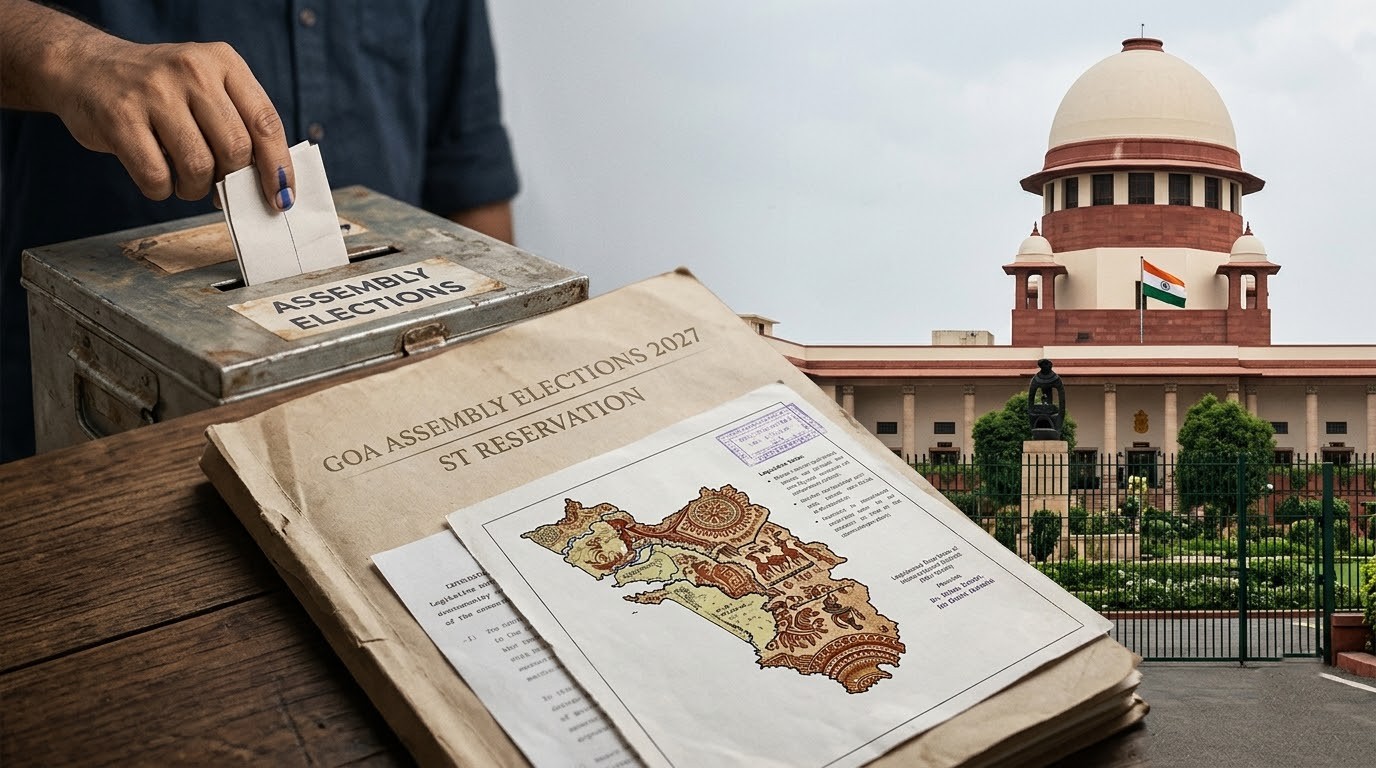
The Goa government has decided to approach the Supreme Court this week to challenge an interim order passed by the Panaji bench of the Bombay High Court that restrained the Census Commissioner from notifying population estimates for Scheduled Tribes in the state. The decision was confirmed by Goa NRI Commissioner Narendra Sawaikar, who stated that a special leave petition would be filed by Wednesday to lift the stay and revive the reservation process ahead of the 2027 Assembly elections.
A delegation comprising Goa Assembly Speaker Ganesh Gaonkar, Art and Culture Minister Ramesh Tawadkar, and Sawaikar travelled to New Delhi on Monday to explore legal options. The visit followed the High Court's interim direction, which officials said created uncertainty over the proposal to reserve four Assembly constituencies for Scheduled Tribes before the next elections.
Statutory Framework Under Challenge
The litigation concerns the constitutional validity of the Readjustment of Representation of Scheduled Tribes in Assembly Constituencies of the State of Goa Act, 2025. Parliament passed the legislation in August 2025 and it came into force in August 2026. The Act provides for determining Goa's Scheduled Tribe population and redrawing Assembly constituencies to enable political reservation for the community.
Why did the Bombay High Court stay the ST reservation process in Goa?
A division bench of Justices Valmiki Menezes and Amit S Jamsandekar issued the interim stay while hearing a petition challenging the 2025 Act. The bench questioned the Census Commissioner's decision to assume that Scheduled Tribes accounted for 9.9 per cent of Goa's population based on the 2001 Census. The Commissioner acknowledged that available data did not allow an accurate assessment of the current population. The court held that population figures could not be determined using any basis other than the first official Census conducted after 2026.
Historical Data and Community Inclusion
The bench noted that the Kunbi, Gauda, and Velip communities were added to the Scheduled Tribes list in January 2003. However, the 2001 Census had recorded only 566 tribal people across Goa. This discrepancy formed a central plank of the court's reasoning that the 2001 data was an unreliable basis for determining present population figures for the purpose of political reservation.
Aspect | Census Commissioner's Approach | High Court's Observation |
|---|---|---|
Data Source | 2001 Census | First official Census after 2026 |
Assumed ST Population | 9.9 per cent | Cannot be determined without fresh Census |
Key Communities | Kunbi, Gauda, Velip (added 2003) | Not captured in 2001 Census (only 566 persons recorded) |
Commissioner's Admission | Data insufficient for accurate assessment | Validates need for updated enumeration |
Tribal organisations and community leaders in Goa have long sought political reservation and representation in the state legislature. The government's move to invoke the Supreme Court's jurisdiction aims to ensure that the statutory mechanism enacted by Parliament can be implemented within the timeline required for the 2027 Assembly elections. The outcome of the special leave petition will determine whether the process of identifying the tribal population and redrawing constituencies can proceed without waiting for the next decennial Census.