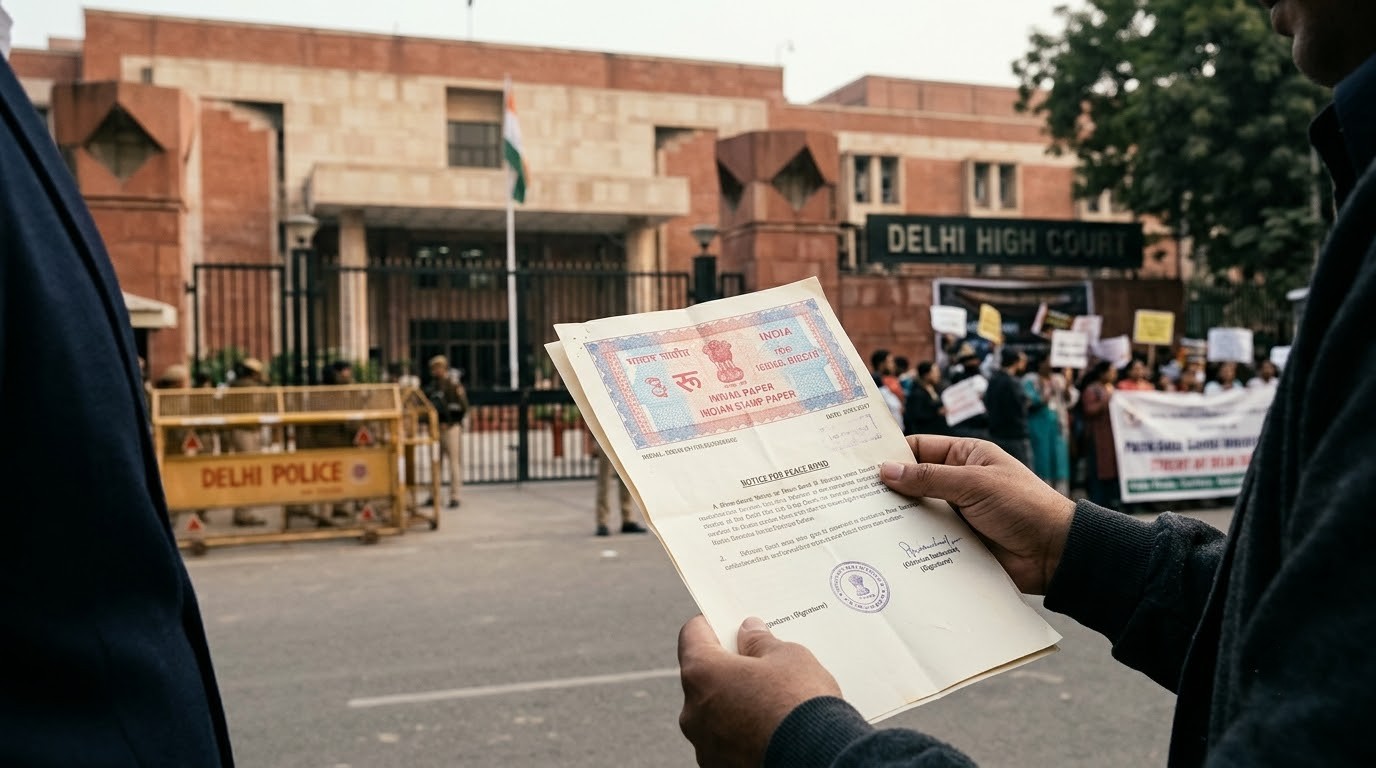
The Delhi High Court has reserved its verdict on a petition filed by Neha Bora, National President of the All India Students Association, challenging a notice issued by a Special Executive Magistrate in connection with alleged disturbance of peace following the “Lehra Do Tiranga” protest on October 16.
The notice sought execution of a personal bond of Rs 10,000 with one surety to maintain peace during an inquiry. It was issued under Sections 126, 130 and 135(3) of the Bharatiya Nagarik Suraksha Sanhita, 2023, or BNSS.
Justice Subramonium Prasad heard the parties for more than two and a half hours and reserved the verdict. The judge indicated that the orders would be pronounced on Friday at 6 pm. The evidence available before the court did not contain the reasons for the reservation or the court’s final determination on the challenge.
What legal power was exercised by the magistrate?
Under Section 126 of the BNSS, a magistrate may show cause to an individual against whom information has been received indicating that the person is likely to commit a breach of peace or disturb public tranquillity. Section 130 requires a written order mentioning the particulars of the information received and the reasons for requiring the person to show cause. Section 135(3) permits a magistrate, for reasons recorded in writing, to direct a person against whom an order has been made under Section 130 to execute a bond or bail bond for keeping the peace or maintaining good behaviour until the conclusion of the inquiry.
The statutory framework therefore separates the stages of the proceedings. The magistrate may initially require an individual to show cause, inquire into the truth of the information and, subject to the statutory conditions, require security for keeping the peace or maintaining good behaviour. The challenge in the present case concerned both the authority invoked to issue the notice and the sufficiency of the material on which the magistrate acted.
What did Bora’s counsel argue about the notice?
Senior advocate Gopal Sankaranarayanan, appearing for Bora, submitted that the protest organised for October 16 was peaceful and that she had not called for violence. He said that Bora was detained at Mandi House after the protest for approximately 10 to 15 minutes, although she had not committed any offence or breached the peace.
He further submitted that Bora was not involved in a separate protest organised by the CJP to unfurl the National Flag at Connaught Place Central Park. According to counsel, Bora was also not permitted to contact her family or lawyers immediately after her detention.
Counsel argued that the executive magistrate had relied on information that amounted to hearsay and had not conducted the necessary preliminary inquiry. He contended that the notice did not contain the essential requirements prescribed by Section 136, which deals with the order to give security. In his submission, the magistrate’s satisfaction could not be established merely through a mechanical show-cause notice, particularly where an interim bond was being sought.
He also stated that the stage for execution of a personal bond had not arisen. On his argument, the show-cause notice is intended to enable the magistrate to consider, during the inquiry, why a peace bond should not be required. Section 136 becomes relevant after the inquiry has been completed, when the magistrate may determine whether a bond for maintaining good behaviour should be imposed.
Counsel also challenged the fact that the executive magistrate was an Assistant Commissioner of Police and questioned whether the notice possessed the required substance. He further submitted that Section 163 had not been invoked in the area from which Bora was detained, although loudspeaker announcements referred to the provision.
What did the Delhi Police submit?
Additional Solicitor General Chetan Sharma began his submissions for the Delhi Police. During the hearing, Justice Prasad examined whether a magistrate may issue a notice under Section 126 on the basis of information received from another person without first conducting an independent inquiry to satisfy himself about the presence of the person alleged to have disturbed the peace.
The judge’s oral observation placed emphasis on the need to verify the foundational information before the statutory process is initiated. The available evidence did not set out the complete submissions made on behalf of the police or the court’s final response to them.
What is the status of Neha Bora’s challenge to the peace bond notice?
The Delhi High Court has reserved its verdict on Neha Bora’s challenge to the notice issued under Sections 126, 130 and 135(3) BNSS. The central question is whether the magistrate was satisfied on the information available and whether the notice satisfied the statutory requirements before directing a personal bond of Rs 10,000 with one surety during the inquiry.
Until the reserved orders are pronounced, the court has neither invalidated the notice nor recorded a final finding that the magistrate acted lawfully. The court’s operative ruling and reasons will determine whether the challenge is allowed and whether the proceedings concerning the personal bond may continue.