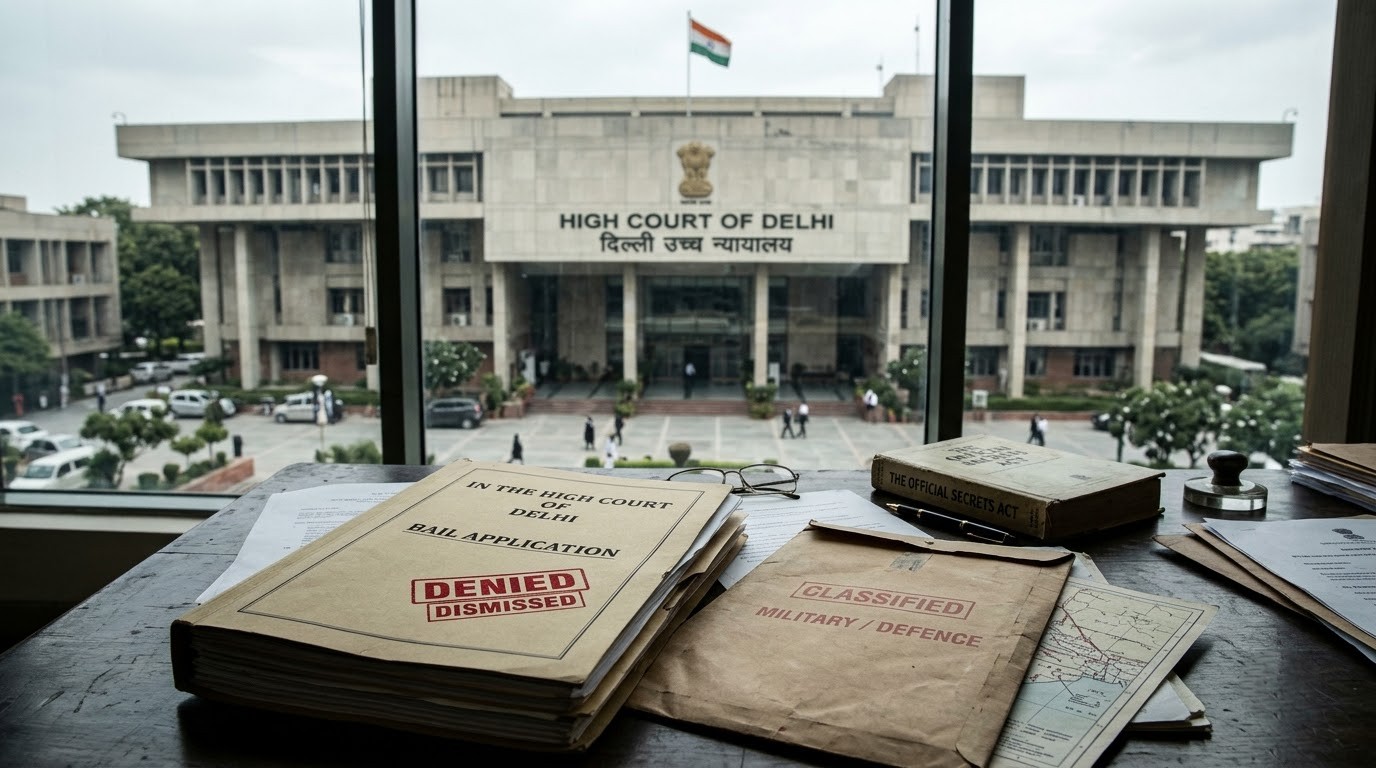
The Delhi High Court has rejected the bail application of Habib Ur Rahman, an accused in a case involving alleged possession and transmission of classified military and intelligence documents to an official of the Pakistan High Commission.
Justice Sanjeev Narula observed that although allegations affecting national security require careful scrutiny, they do not remove the matter from the court’s bail jurisdiction. The invocation of the Official Secrets Act, 1923, and the possibility of a sentence extending to 14 years cannot, by themselves, conclusively determine the outcome of a bail application.
What did the Delhi High Court hold on the prosecution’s case against Habib Ur Rahman?
The court held that the prosecution case could not be characterised as resting exclusively on a disclosure statement or an uncorroborated allegation. The material placed before it included recovered documents, financial transactions, call detail records and the statement of Rahman’s employee, who alleged that he delivered documents to the Pakistan High Commission on Rahman’s instructions. These materials justified a prima facie assessment adverse to the accused, although the court did not determine whether the prosecution would ultimately prove its case.
Rahman was arrested in July 2021 after the Crime Branch registered an FIR under Sections 3 and 9 of the Official Secrets Act, 1923, together with provisions of the Indian Penal Code. The prosecution alleged that classified military documents recovered from him concerned military training, the operationalisation of the Armed Forces Special Operations Division and intelligence matters.
According to the prosecution, Army authorities verified the recovered material as genuine, classified and sensitive. The State also relied on Rahman’s alleged intermediary role between co-accused Naik Clerk Paramjeet Kumar and Rana Muhammad Qasim Zia, identified in the proceedings as an official of the Pakistan High Commission.
Justice Narula distinguished the stage at which the court was deciding the application from the evidentiary determination required at trial. The court stated that it was not required to decide whether the circumstances relied upon by the prosecution would ultimately be established or what weight the materials would command during trial. A closer examination of the evidence at that stage could amount to the evidentiary assessment that a bail court is required to avoid.
Did the medical condition of the accused entitle him to bail?
No. The medical record indicated that Rahman was wheelchair-dependent, needed assistance with daily activities and suffered from several ailments. The court nevertheless found that the record did not establish that the prescribed treatment could not be provided in custody or that his continued incarceration was medically incompatible with his condition. His health therefore did not outweigh the court’s prima facie assessment of the prosecution material.
The court also considered the substantial period of Rahman’s custody, his compliance with interim bail conditions and the absence of any allegation that he had misused the liberty granted to him. These factors weighed in his favour, but did not produce the result sought by the accused.
Dismissing the bail application, the court directed the trial court to accord due priority to the matter and endeavour to record prosecution evidence expeditiously. It also directed the Jail Superintendent to ensure that every investigation, specialist consultation, physiotherapy course and other treatment advised for Rahman was provided without avoidable delay. Treatment or consultation unavailable within the jail was to be arranged at an appropriate government hospital.
The order therefore rests on an assessment of the prima facie material, not a finding of guilt. The court found sufficient grounds to deny bail while requiring the trial to proceed expeditiously and ensuring access to the medical care identified in the record.