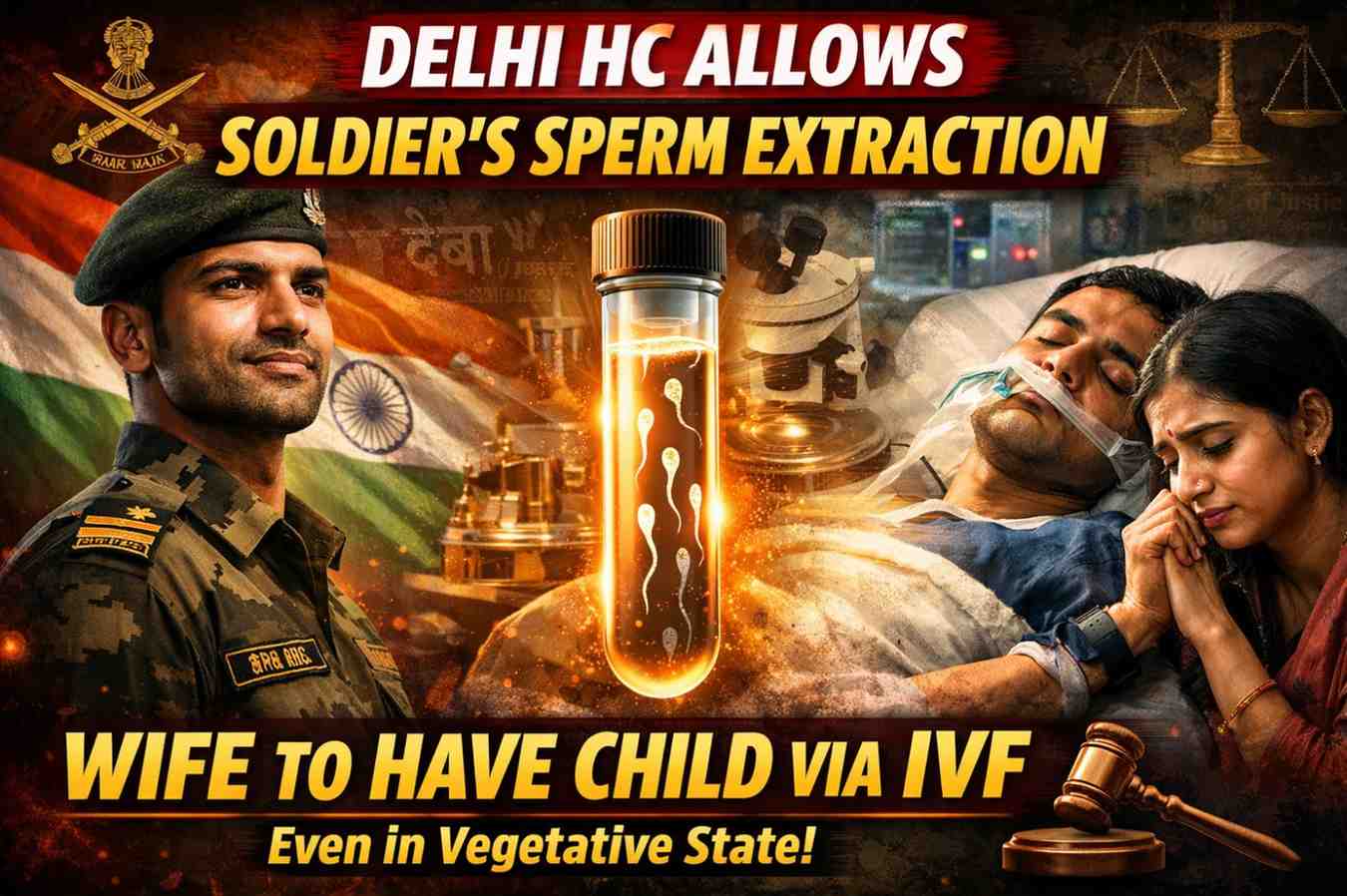
The Delhi High Court has granted a landmark permission to the wife of an Indian Army soldier, currently in a persistent vegetative state, to extract and cryopreserve his sperm for Assisted Reproductive Technology (ART). Justice Purushaindra Kumar Kaurav, in a judgment released on April 15, 2026, held that the couple’s prior mutual decision to undergo In-Vitro Fertilization (IVF) before the soldier's incapacitation constitutes sufficient "informed consent" under the law.
The case involved Lance Naik Kumar, who suffered a severe traumatic brain injury in July 2025 during a patrol in Jammu & Kashmir. The couple had married in 2017 and began their IVF journey in 2023. After the accident, the process was halted because the Assisted Reproductive Technology (Regulation) Act, 2021 typically requires fresh written consent from both parties. The court, however, ruled that requiring a "physically impossible" fresh signature would frustrate the couple’s existing reproductive plans and the wife's fundamental rights.
Central to the ruling was the interpretation of Article 21 of the Constitution. Justice Kaurav emphasized that the right to reproductive autonomy is a fundamental right. He noted that the ART Act must be interpreted in a way that "furthers the said right, and not derogates from it." By treating the husband's initial active participation in the IVF process as ongoing consent, the Court prevented a procedural technicality from ending the petitioner's hopes of parenthood.
Interestingly, the judgment invoked ancient wisdom to contextualize the ethics of the decision. Justice Kaurav quoted the Śrīmad Bhāgavatam, stating, "A living being obtains a body under the supervision of Daiva" (destiny), to remark that while science can facilitate the process, the ultimate outcome of parenthood is not in human hands. This philosophical touch underscored the Court's view that the law should not "interdict the fate" of the petitioner by imposing impractical barriers.
While the medical board at the Army Hospital noted that the chances of retrieving viable sperm from a patient in such a state were "meagre," the High Court maintained that the technical difficulty should not be a legal ground for denial. The ruling directs the authorities to treat the wife's consent as valid for her husband for all subsequent IVF procedures. This decision sets a vital precedent for "posthumous" or "incapacitated" reproduction in India, prioritizing the documented intent of a couple over rigid contemporary consent requirements.