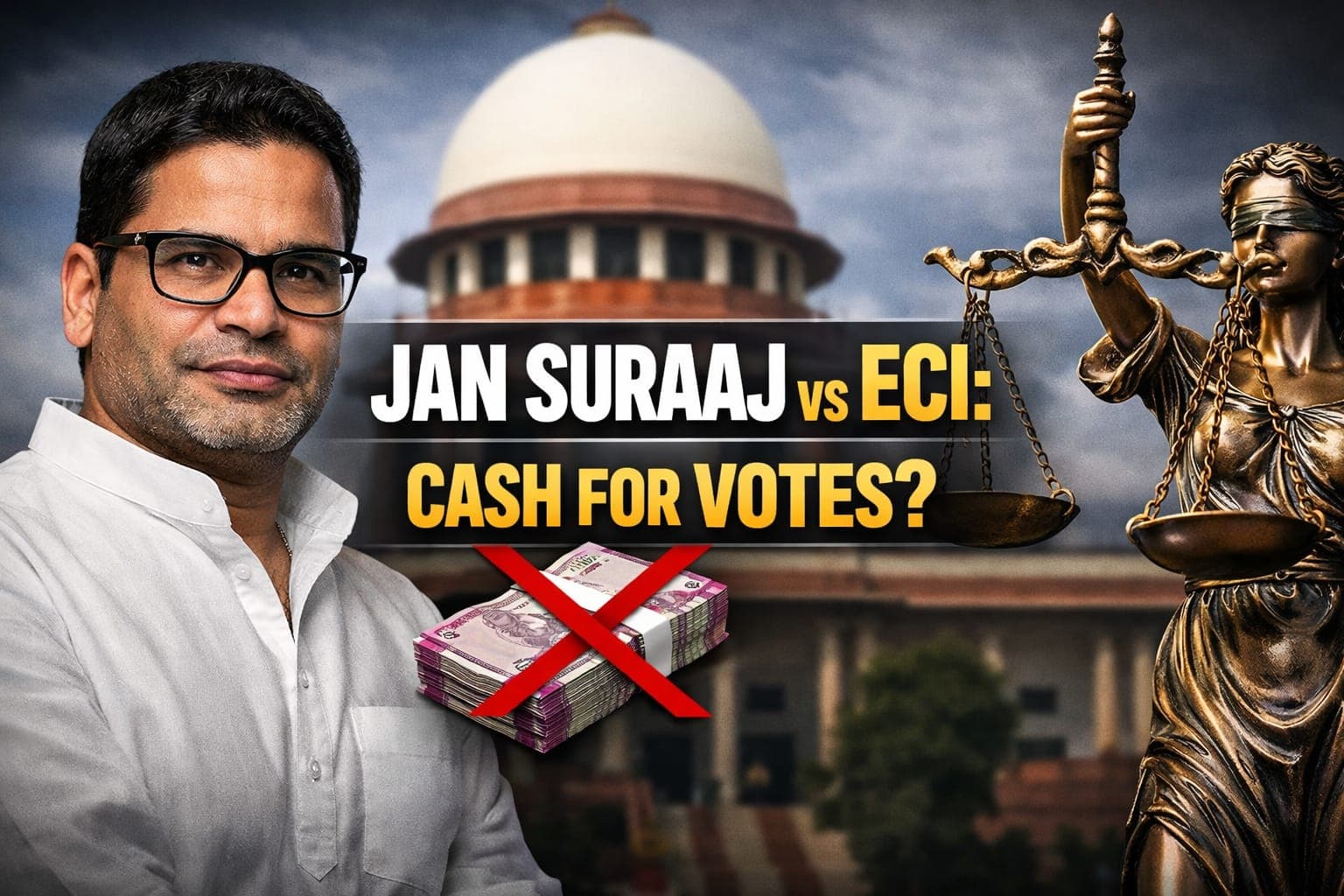
New Delhi: The fallout of the 2025 Bihar Assembly Elections has reached the doorstep of the Supreme Court. The Jan Suraaj Party, founded by ace political strategist turned politician Prashant Kishor, has filed a comprehensive petition challenging the conduct of the recently concluded polls. The party has alleged that the ruling dispensation engaged in "corrupt practices" by using state welfare schemes to offer cash inducements to voters under the guise of women's empowerment.
The petition, Jan Suraaj Party vs. The Election Commission of India, raises fundamental questions about the "level playing field" in Indian democracy and whether the release of direct cash benefits during the operation of the Model Code of Conduct (MCC) vitiates the sanctity of the electoral process.
At the heart of the legal battle is a specific welfare scheme launched by the Nitish Kumar-led government just before the election bugle was sounded: the Mukhyamantri Mahila Rojgar Yojana.
Under this scheme, the State government pledged to transfer ₹10,000 directly to one woman in every family to encourage self-employment. The scheme further promised an additional ₹2 lakh following a post-election assessment. Jan Suraaj argues that while the intent of the scheme on paper was "employment," its execution during the election period served as a sophisticated tool for "cash-for-votes."
The petition highlights a significant discrepancy in the numbers. Eligibility for the scheme was tied to JEEVIKA, Bihar’s well-known network of women’s self-help groups.
According to Jan Suraaj’s plea:
- Approximately 1 crore women were associated with JEEVIKA before the Model Code of Conduct came into force.
- However, newspaper reports cited in the petition suggest that nearly 1.56 crore women eventually received payments.
The party alleges that these additional 56 lakh beneficiaries were enrolled and paid after the election schedule was announced, directly violating the Election Commission’s (ECI) standing instructions. The ECI guidelines strictly prohibit the expansion of beneficiary lists or the release of fresh funds once the MCC is in effect if such actions are likely to influence voter behavior.
Beyond the financial aspect, the petition flags a procedural irregularity. It claims that women who had recently received these cash benefits were deployed as "volunteers" or staff at polling booths during both phases of the Bihar elections. Jan Suraaj contends that having direct beneficiaries of a ruling party’s scheme managing or present at the booths compromised the neutrality of the voting environment, potentially intimidating or influencing other voters.
The legal challenge isn't limited to the Representation of the People Act; it extends to constitutional discipline. The Jan Suraaj Party has raised two major technical points:
- Violation of Article 267: The plea claims that the funds for this massive rollout were withdrawn from the State’s Contingency Fund without proper legislative sanction or being part of the regular budgetary process.
- The "Basic Structure" Argument: Relying on landmark Supreme Court precedents, the petition argues that "free and fair elections" are a part of the Basic Structure of the Constitution. It contends that using the state treasury to create a "committed voter base" on the eve of an election is an assault on Articles 14 (Equality), 21 (Right to Life/Dignity), and 324 (Superintendence of Elections).
A significant portion of the grievance is directed at the Election Commission of India. The Jan Suraaj Party alleges that despite clear evidence of cash being pumped into the hands of voters during the campaign period, the ECI failed to intervene or stay the transfers. The petition suggests that the "level playing field"—a cornerstone of democracy—was destroyed as the ruling coalition used state resources that no opposition party could match.
The Jan Suraaj Party contested 242 out of 243 seats in the 2025 Bihar polls but failed to win a single seat. While critics might view this as "sour grapes," the legal questions posed are significant. If a government can bypass the spirit of the Model Code of Conduct by labeling cash transfers as "ongoing welfare," it sets a precedent for future state and national elections.
The Supreme Court, led by a bench including Chief Justice of India Surya Kant, is expected to hear the matter urgently. The outcome of this case could redefine the boundaries between "legitimate welfare" and "electoral bribery" in the digital age of Direct Benefit Transfers (DBT).
As Bihar waits for the legal verdict, the case serves as a reminder that the battle for the "voter's mind" is increasingly being fought not just on the ground, but in the hallowed halls of the judiciary.