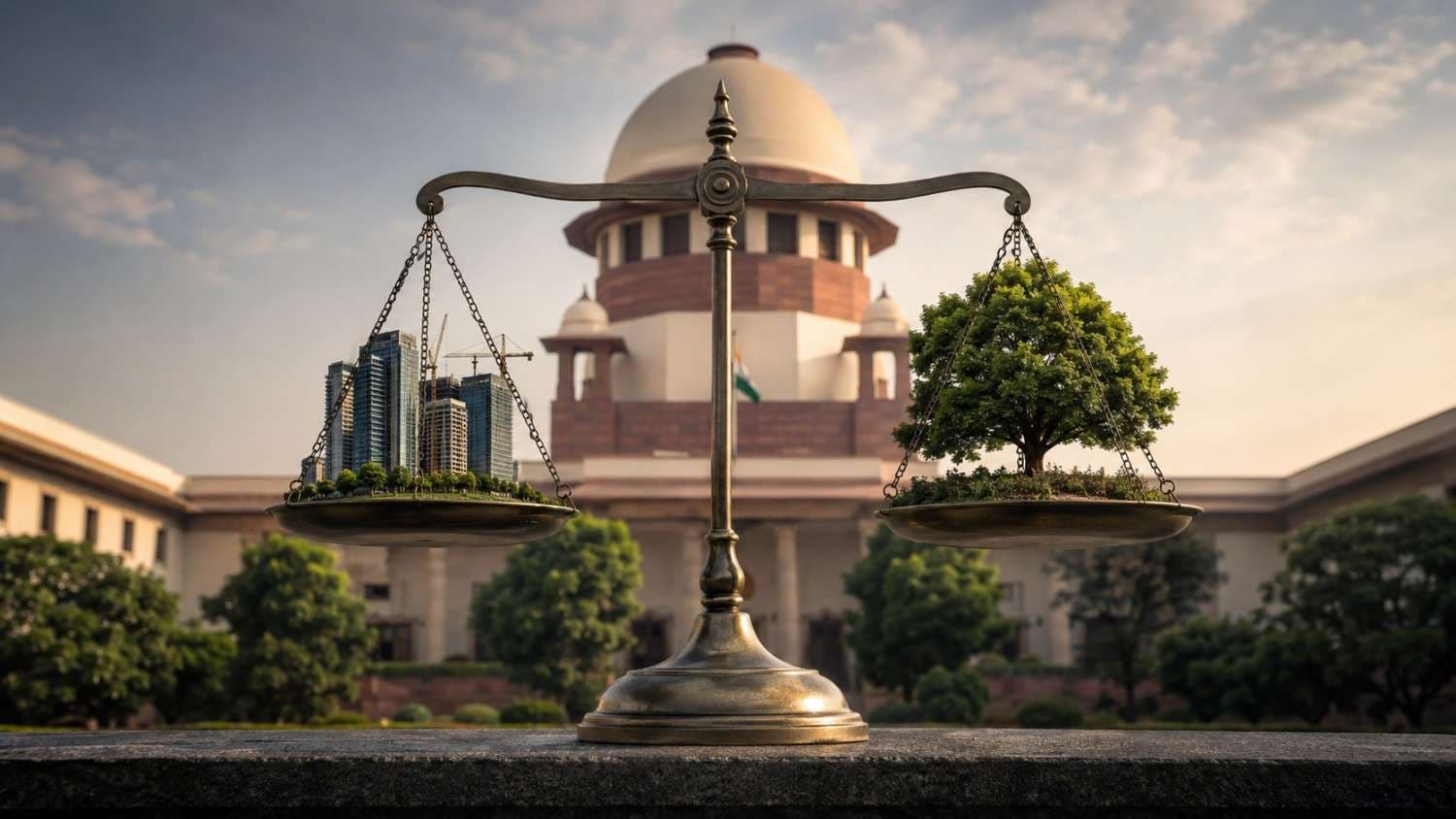
Chief Justice of India Surya Kant cited the Supreme Court's judgment in Bindu Kapurea v. Subhashish Panda & Ors. as an illustration of judicial creativity in balancing environmental preservation with developmental needs. Speaking at the High-Level Commonwealth Policy Dialogue on Climate Justice held at the Commonwealth Secretariat in London on August 28, the CJI described how the Court responded to the conflict between protecting the Delhi Ridge and facilitating access to a paramilitary hospital.
The case originated from the illegal felling of protected trees along a stretch from Main Chhattarpur Road to SAARC Chowk, Gaushala Road, and onward to the Central Armed Police Forces Institute of Medical Sciences (CAPFIMS) hospital. The tree removal occurred without the prior permission mandated by earlier Supreme Court orders, prompting contempt proceedings against officials of the Delhi Development Authority (DDA). An Expert Committee appointed by a bench comprising Justices Abhay S Oka and Ujjal Bhuyan, which examined the matter in June-July 2024, found that the felling had proceeded without assessments for rainwater harvesting, ecological restoration, or other mitigatory measures.
The petitioners contended that the road-widening project was pursued to circumvent the land acquisition process that would have been required for an alternative route through private farmhouses in Chhattarpur. The bench led by Justice Oka had earlier expressed strong disapproval, noting evidence suggesting the involvement of the then Lieutenant Governor of Delhi, VK Saxena, in his ex-officio capacity as DDA Chairman, and warned of possible contempt proceedings against him for alleged cover-ups.
Due to overlapping proceedings, the matter was transferred before it reached the bench led by CJI Surya Kant and Justice N Kotiswar Singh. After earlier recusals and transfers—including a referral from a bench led by Justice BR Gavai, a shift to a bench under former CJI DY Chandrachud, and the recusal of CJI Sanjiv Khanna—the case came before Justice Surya Kant’s bench, which declared it would hear the matter afresh.
In its May 2025 judgment, the bench held that the respondents had committed contempt of court by failing to seek judicial permission for the tree-felling and by actively concealing the violation. The Court determined that the deliberate non-disclosure undermined the judicial process and constituted criminal contempt. However, the judgment also acknowledged the nature of the CAPFIMS project, which provides medical care to paramilitary personnel and their families.
The Court observed that ensuring access to quality medical care for such personnel is not a privilege but a necessity, and that these individuals often lack a voice in public deliberations. Weighing these factors, the bench concluded that the overarching public interest supported consideration of the hospital’s developmental needs.
Rather than ordering a cessation of the road project, the Court directed extensive compensatory afforestation as a remedial measure. The CJI emphasized that the Court’s involvement did not end with the judgment, noting that it continues to monitor the afforestation effort through periodic reports filed before it. He stated that a sapling planted and then forgotten cannot serve as a meaningful remedy, and that sustained oversight is essential to ensure ecological restitution.
The CJI presented the case as a modest but significant example of a broader principle: that environmental protection and development need not be treated as mutually exclusive goals. He asserted that courts can, through judicial creativity, identify solutions that advance both objectives, avoiding the false dichotomy of choosing one over the other. The approach taken in the Delhi tree-felling matter, he said, reflects the judiciary’s role in fostering outcomes where preservation and progress coexist.