The Bombay High Court, sitting at its Kolhapur bench, recently passed an order granting bail and suspending the sentence of life rigorous imprisonment imposed on Ashwini Chavan and Sachin Kumbhar. The duo had been convicted by the Sessions Court in Wai, Satara District on 30 January 2025 for the offence of causing the death of Chavan’s ten‑year‑old son by drowning him in a canal. The conviction was based on the prosecution’s case that the child had learnt about the alleged extra‑marital relationship between Chavan and Kumbhar and would have disclosed it to his father, thereby providing a motive for the killing.
A division bench comprising Justice Milind Jadhav and Justice Nandesh Deshpande examined the interim applications filed by both accused seeking bail and suspension of sentence pending the hearing of their criminal appeals, which were instituted in 2025. In its order dated 3 July 2026, the bench set out the reasons for granting the relief.
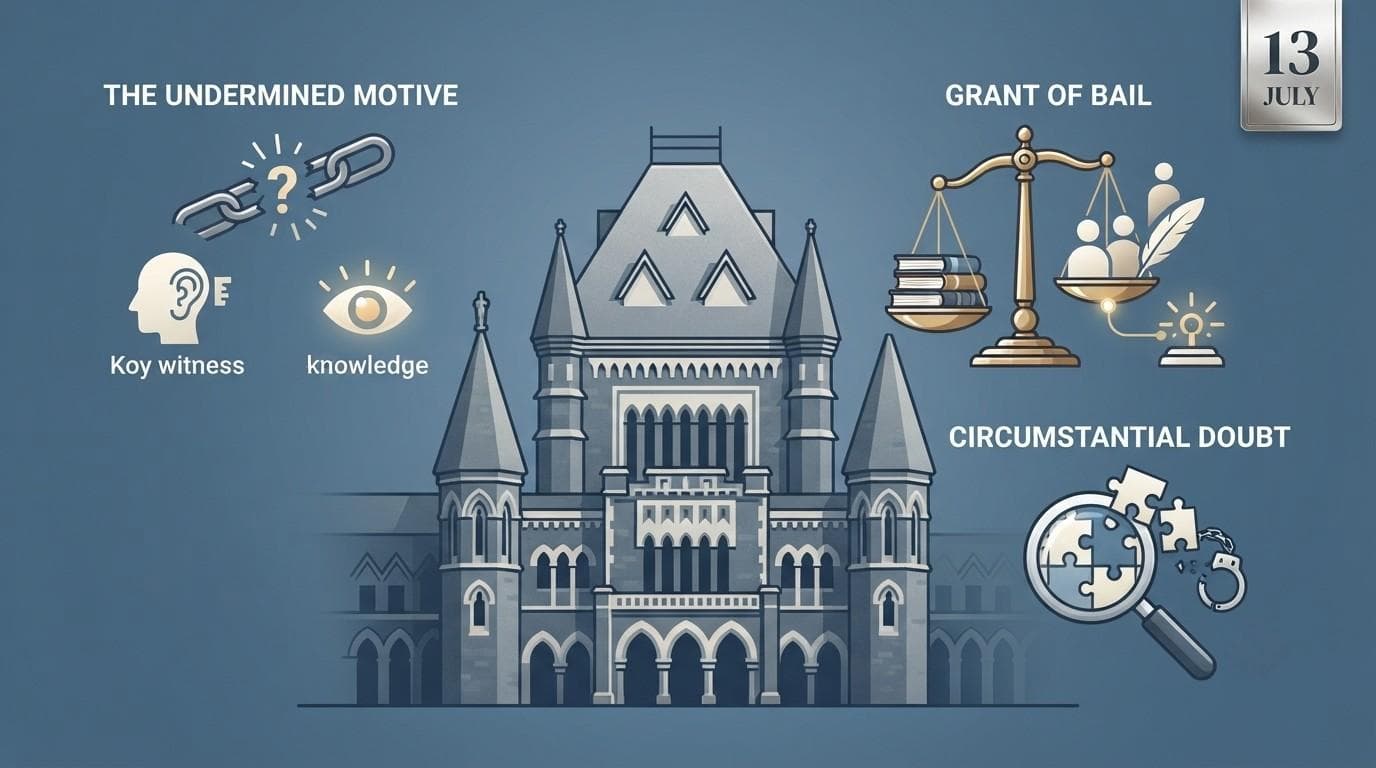
The judges first noted that the evidence led by the prosecution was entirely circumstantial. No direct evidence linking the accused to the act of drowning was placed on record. The prosecution’s theory rested on the alleged motive that the child, having become aware of the affair, would inform Chavan’s husband, prompting the accused to eliminate him to prevent the disclosure.
Crucially, the bench referred to the testimony of PW‑5, the husband of Ashwini Chavan. According to the record, PW‑5 expressly stated that he was already aware of the alleged extra‑marital relationship between his wife and Sachin Kumbhar. The judges observed that this testimony undermined the prosecution’s motive, as the husband’s prior knowledge rendered the alleged fear of disclosure untenable. Consequently, the motive attributed to the accused was deemed prima facie defeated.
While acknowledging that the weakness of the motive does not automatically acquit the accused, the bench emphasized that the ultimate determination of guilt would await the hearing of the criminal appeals. The judges observed that there was little prospect of the appeals being decided in the near future, given the stage of the proceedings.
In light of the circumstantial nature of the evidence, the undermined motive, and the pendency of the appeals, the bench concluded that continued incarceration would serve no purpose at this stage. Accordingly, it allowed the intervention applications, granted bail to both Chavan and Kumbhar, and suspended the execution of their life sentences until the appeals are finally disposed of.
The order also recorded the appearances of counsel. Advocates Rizwan Merchant, Sagar Shete, Sultan Khan, Arya Ambulkar and Aditya Raktade appeared for Sachin Kumbhar, while Advocate Shreyas Barsawade represented Ashwini Chavan. The State was represented by Additional Public Prosecutor Shrikant Yadav.
The case is cited as Sachin Shivram Kumbhar vs State of Maharashtra (Interim Application 1905 of 2025), with the Bombay High Court’s judgment reported as 2026 LiveLaw (Bom) 328. The bench’s decision underscores the appellate court’s approach to bail and suspension of sentence when the prosecution’s case relies heavily on circumstantial evidence and the alleged motive is contradicted by the testimony of a key witness.