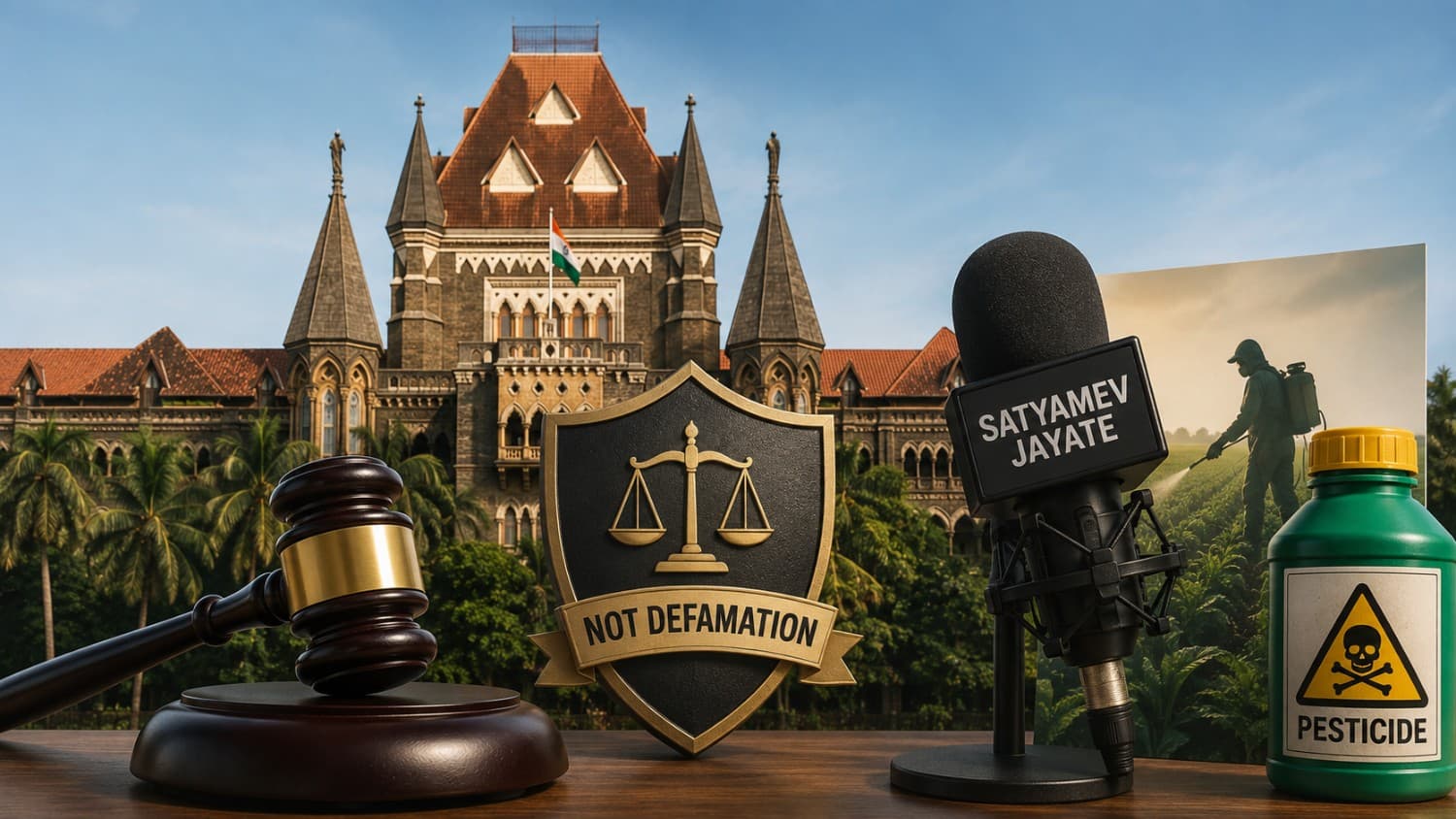
The Bombay High Court on Tuesday quashed a First Information Report (FIR) lodged in 2015 against two doctors for alleged criminal defamation arising from their participation in Aamir Khan’s ‘Satyamev Jayate’ television programme aired in June 2012. The FIR was filed by the Crop Care Federation of India Limited (CCFIL), which claimed to be defamed by the doctors’ remarks on the adverse effects of excessive pesticide and insecticide use on human health.
Single-judge Justice Milind Jadhav heard the applications filed by Dr Rashmi Sanghi and Dr Gopal Kabra seeking to quash the criminal proceedings initiated against them. The court noted that Dr Sanghi spoke for approximately 40 seconds and Dr Kabra for three to four minutes during the programme, both having been invited by the show’s producers to respond to queries raised by the host.
According to the transcript of the programme examined by the bench, Dr Sanghi discussed the contamination of breast milk due to the excessive use of insecticides and pesticides in agriculture, while Dr Kabra highlighted the link between such chemical use and congenital deformities in newborn babies, including skull abnormalities arising from folic acid deficiency in pregnant mothers.
CCFIL alleged that the statements defamed its members, who are manufacturers and marketers of insecticides and pesticides, by imputing negligence or harmful intent to the entire industry. However, Justice Jadhav observed that neither doctor mentioned any specific pesticide, insecticide, manufacturer, or producer by name during their appearances. The judge emphasized that the remarks were general in nature, referring only to the broad category of agrochemicals and their potential health impacts when used excessively.
In his order, Justice Jadhav stated: ‘In my opinion, the entire case filed by the Complainant virtually turns on its heads in view of the fact that admittedly both Applicants have not made any mention whether direct or indirect about the use of any particular pesticide or insecticide as being teratogenic or being responsible for any birth defects or deformities, neither have they mentioned or taken the name of any manufacturer or producer of insecticides or pesticides in a negative or defamatory manner which would amount to casting insinuation or imputation on any of the members of the Complainant/ NGO/ Organization or for that matter any person / manufacturer concerning the insecticide / pesticide industry.’
The judge further noted that the presence of other experts and public figures in the same programme, who advocated for organic farming and pesticide regulation, underscored the general and educational nature of the discussion. He concluded that the doctors’ statements were made in the course of spreading awareness about scientifically observed health and environmental hazards, based on contemporaneous studies and their own research.
Justice Jadhav added: ‘On overall consideration of the facts in the present case it is seen that the discussion on the TV show program was to spread awareness about the side effects and ill effects of excessive use of pesticides and insecticides or other teratogenic material on human health and its impact on environment and ecology and to discuss and deliberate on alternate methods of farming which are less harmful. I do not find a singular intentional or malicious or false statement made by the Applicants while answering the questions so as to indict either a particular pesticides or insecticides and/or the manufacturers and marketers of pesticide and insecticide or concerning any member of the Complainant.’
The bench held that the allegations in the complaint, as interpreted by the Magistrate, assumed a direct attack on specific products or manufacturers, which was absent from the actual statements. Since the essential ingredients of Section 499 of the Indian Penal Code, 1860 — namely, the making or publishing of any imputation concerning a person with intent to harm reputation — were not satisfied, the court concluded that no offence of criminal defamation was made out.
Accordingly, the FIR lodged against Dr Rashmi Sanghi and Dr Gopal Kabra was quashed. The court emphasized that expressions made in public interest, particularly on matters of health and environmental safety, must be protected when they are general, bona fide, and devoid of malice or specificity targeting identifiable individuals or entities.