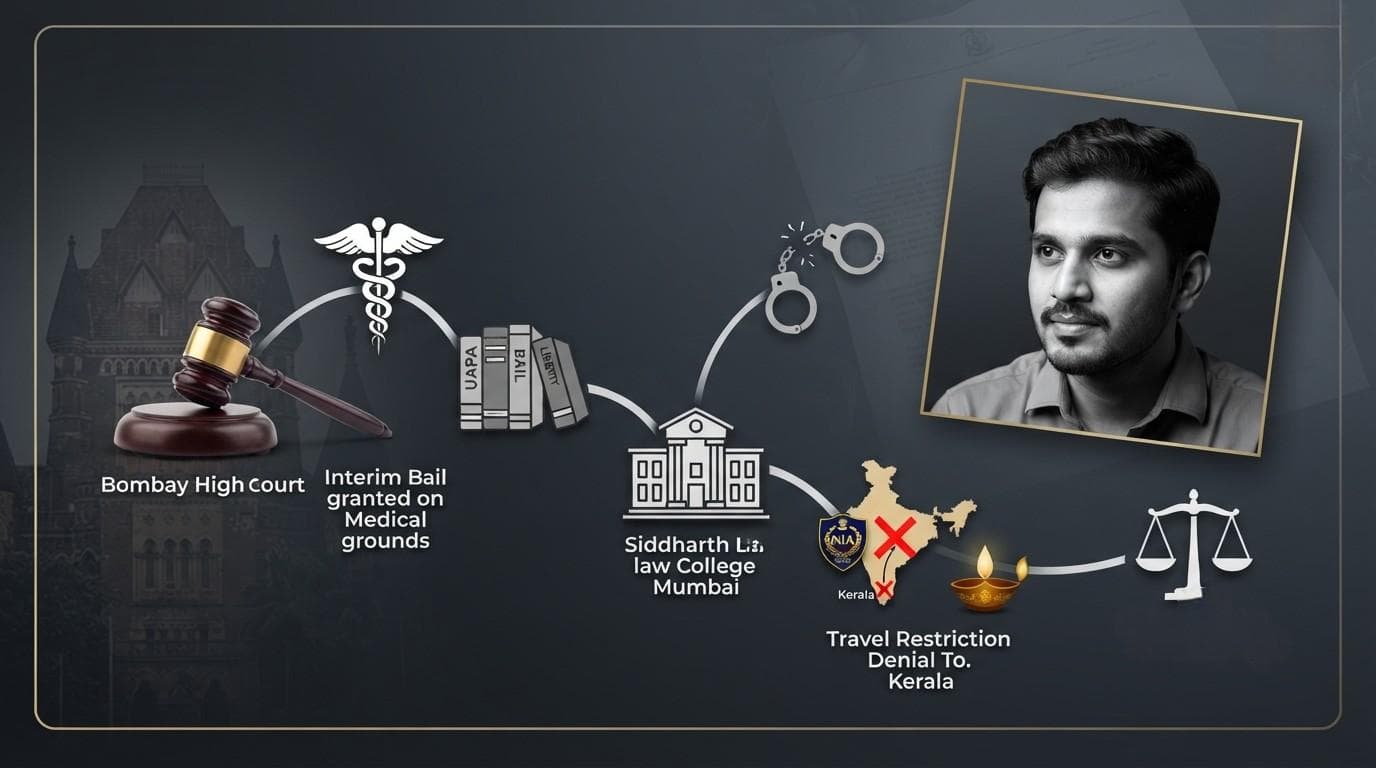
Mahesh Raut, a forest rights activist, is charged under Section 15 of the Unlawful Activities (Prevention) Act, 1967 for allegedly committing a terrorist act in connection with the Bhima Koregaon violence of 2018. In September 2023 the Bombay High Court granted him bail after observing prima facie that there was no evidence against him. The bail order was subsequently stayed by the High Court itself, and the stay was extended by the Supreme Court. The Supreme Court later granted him interim bail on medical grounds, which lapsed after a period, resulting in his return to judicial custody.
In September 2024 the Bombay High Court directed the Siddharth Law College in Mumbai to admit Raut as a student, holding that incarceration does not curtail an individual’s right to pursue further education. This order underscored the court’s view that certain personal liberties, including education and health care, remain protected even while under judicial restraint.
Special NIA Court’s January 2026 Order
In January 2026 Raut filed an application before the special NIA court in Mumbai seeking permission to travel to Poonthottam Ayurvedasram in Kerala for a period from 29 January to 7 February 2026. He stated that the travel was necessary for Ayurvedic treatment of rheumatoid arthritis and Sjogren’s syndrome, conditions he alleged required specialised care unavailable in Mumbai. The application also sought a relaxation of the bail condition that restrained him from leaving Mumbai.
The National Investigation Agency opposed the plea vigorously, arguing that allowing travel outside the jurisdiction could jeopardise the investigation and pose a risk of non‑appearance. After hearing the submissions, the special NIA court rejected the application, holding that the medical grounds presented were insufficient to override the travel restriction imposed as part of the bail conditions.
Bombay High Court Pleading
Aggrieved by the special NIA court’s order, Raut has moved the Bombay High Court challenging the denial. His plea contends that the right to obtain proper medical assistance is a fundamental aspect of personal liberty under Article 21 of the Constitution, and that the bail condition prohibiting departure from Mumbai should be relaxed in light of his documented health issues. He points out that the Bombay High Court had previously permitted him to reside in Thane for a limited period on health grounds, indicating a judicial willingness to accommodate medical needs.
The plea further argues that the special NIA court’s reliance on the NIA’s opposition did not adequately consider the medical reports submitted by Raut’s treating physicians, which detail the chronic nature of his ailments and the necessity of specialised Ayurvedic therapy available at the Kerala institution. Raut maintains that the denial effectively deprives him of essential healthcare, thereby violating his constitutional rights.
Legal Implications and Expected Proceedings
The Bombay High Court’s examination of the plea will involve a balancing test between the state’s interest in ensuring the accused’s availability for trial and the individual’s right to health care. Precedents from the Supreme Court and various High Courts have recognised that medical treatment can constitute a valid ground for relaxing travel restrictions, provided that adequate safeguards are in place to guarantee the accused’s presence during proceedings.
If the High Court accepts Raut’s argument, it may impose conditions such as periodic reporting, a surety, or a requirement to return within a stipulated timeframe, thereby addressing the NIA’s concerns while facilitating medical treatment. Conversely, a dismissal would affirm the special NIA court’s discretion to uphold bail conditions despite medical claims, potentially influencing similar applications in other cases under the UAPA.
The matter is scheduled for hearing in due course. The outcome will clarify the extent to which courts may accommodate health‑related requests of persons accused under stringent anti‑terror legislation, and will contribute to the evolving jurisprudence on the interplay between personal liberty and investigative imperatives.