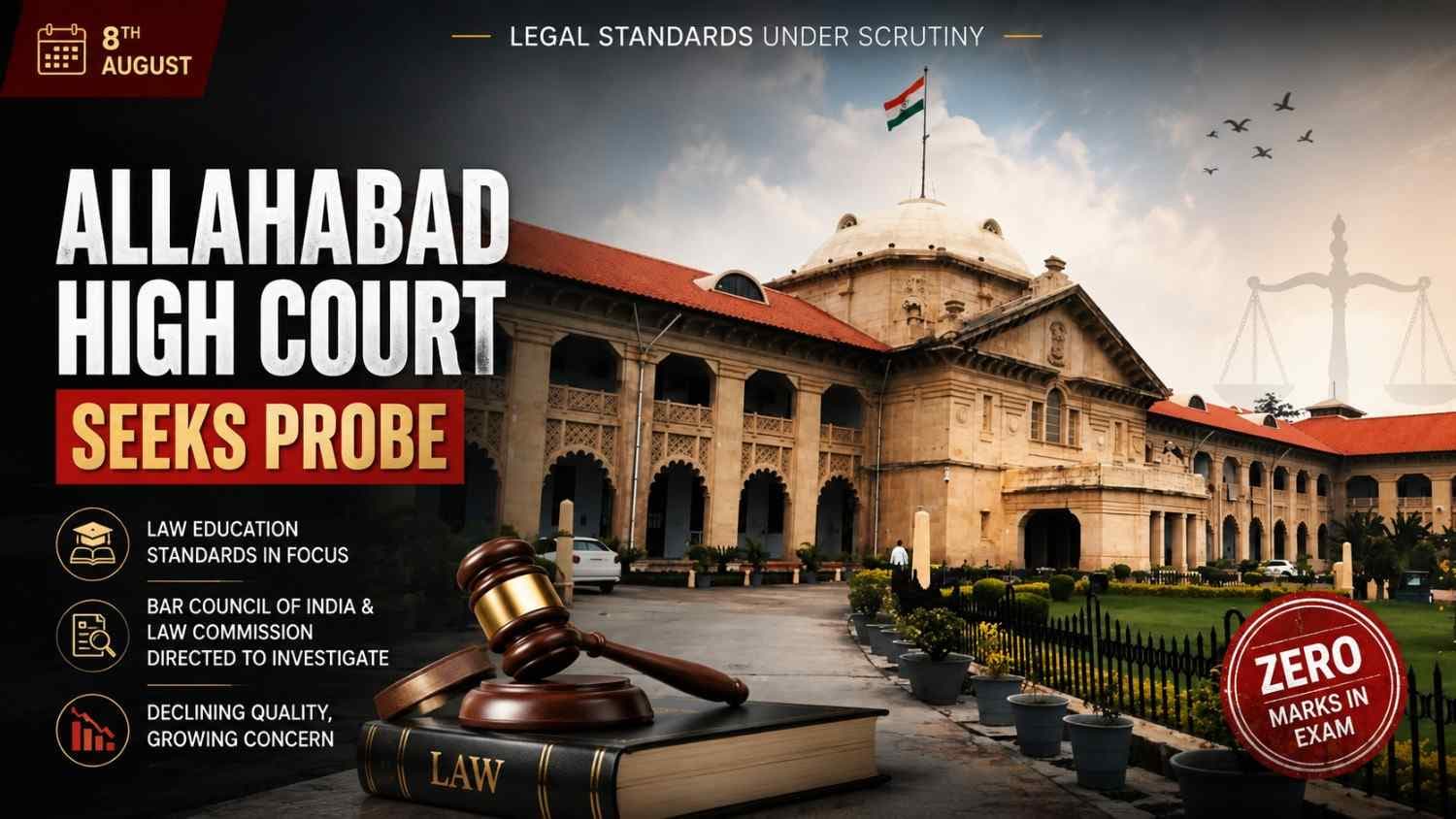
A recent case at the Allahabad High Court has sparked a significant debate regarding the quality of legal education in India. The issue began when a law student, who had successfully cleared eight semesters of their B.A. LL.B. course, was shocked to receive zero marks in every question for a ninth-semester "Bio-Diversity Protection Law" paper. Despite expecting to pass, the student’s results indicated a complete lack of marks, leading them to file a petition in the High Court seeking a re-evaluation of their answer book.
During the legal proceedings, the High Court took a direct approach by requesting the original answer book and question paper to be presented in court. To understand the quality of the work, the presiding judge directed the Standing Counsel to read one of the student's answers aloud in open court. The result was telling: the answer lacked any coherent legal reasoning, factual accuracy, or grasp of the subject matter, effectively justifying the zero-mark grade awarded by the examiner.
While the court dismissed the student's plea, noting that there was no evidence of arbitrariness or bias in the evaluation, the matter did not end there. The judge expressed deep concern over the academic output of a professional law student. The court noted that such a performance raises serious questions about the teaching, supervision, and overall academic environment provided by the institution where the student was enrolled.
The High Court emphasized that legal education is the very foundation of the justice delivery system. A decline in academic standards at the college level does not just affect the individual student; it potentially impacts the future of the legal profession and the broader administration of justice. The court observed that this incident is not an isolated one, highlighting a growing pattern of poor academic performance that warrants immediate attention.
In a landmark directive, the court ordered that a redacted copy of the student's answer book, along with the question paper, be forwarded to the Bar Council of India (BCI) and the Law Commission of India. The objective is to prompt a wider institutional review. The court has asked the BCI to examine whether the existing mechanisms for granting affiliation and conducting periodic inspections of law colleges are truly sufficient to meet the challenges of modern, globally competitive legal standards.
Furthermore, the court urged the Law Commission to investigate these broader issues and consider necessary reforms to enhance legal pedagogy. The court clarified that these instructions were not meant as a personal attack on any specific institution or teacher, but rather as a necessary intervention to bring focus to a systemic problem that risks undermining the integrity of legal practice in the country.
This ruling serves as a stark reminder that merit and academic rigor must remain at the heart of professional education. As the BCI and the Law Commission take up this matter, the hope is that it will lead to stronger oversight and a renewed commitment to excellence in law schools nationwide, ensuring that future graduates are well-equipped to serve the cause of justice.