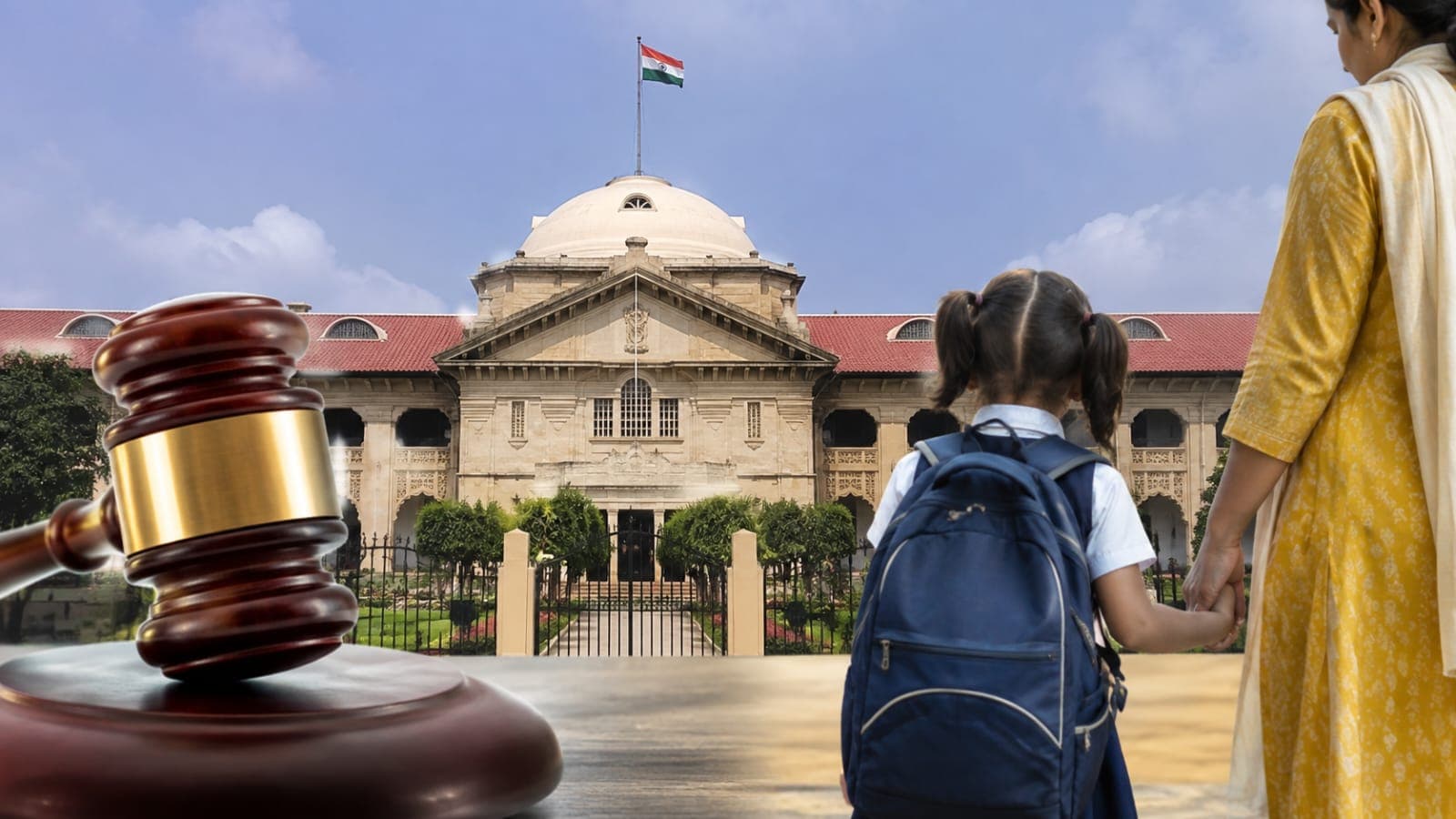
The Allahabad High Court has observed that private schools in Uttar Pradesh affiliated with the Central Board of Secondary Education (CBSE) or the Council for the Indian School Certificate Examinations (CISCE) are not exempt from the obligations imposed under the Right of Children to Free and Compulsory Education Act, 2009 (RTE Act). The Bench of Justice Vinod Diwakar made this clarification while hearing a writ petition concerning St. John’s School, Babhanauti, Pachwal, and emphasized that affiliation with a national board does not override state-specific responsibilities under the RTE framework.
The Court noted that the issue before it pertained to the opportunities available for the education of children belonging to economically weaker sections and socially disadvantaged groups. It referred to the mandate under the RTE Act requiring unaided private schools to admit children from such backgrounds in Class I and provide them free and compulsory elementary education until completion. The Bench specifically acknowledged that it had been brought to its notice that certain private educational institutions recognized by the State Government were reluctant to admit such children and to forego the fees and other charges ordinarily levied by them. However, the Court clarified that it was not expressing any opinion on the correctness of these allegations at this stage, stating that the affidavit being called for would enable the position to be ascertained.
The Bench further observed that schools affiliated with CBSE or CISCE require a No Objection Certificate (NOC) from the State Government for establishment and functioning within Uttar Pradesh and for affiliation with the concerned Board. In view of this requirement, the Court held that such schools, while imparting elementary education within the State, remain subject to the obligations imposed by the State Government in the same measure as any other school, and their affiliation to a Board other than the State Board affords them no exemption therefrom.
Accordingly, the Allahabad High Court directed the State Government to file a comprehensive affidavit addressing the applicability of the RTE Act, 2009, and the State’s resolve to secure quality education for children from economically weaker sections and socially disadvantaged groups. The Court called for a district-wise list of all private primary schools, aided as well as unaided, established and functioning within the State, irrespective of the Board to which they are affiliated. Information on basic schools is to be collated through the Basic Shiksha Adhikari, while information on High Schools and Intermediate Colleges is to be gathered through the District Inspector of Schools.
The State has also been directed to furnish the number of students enrolled in each school, separately for the Junior Basic School stage, Junior High School stage, High School stage, and Intermediate stage. More significantly, the Court has sought school-wise information for each of the last five academic sessions in respect of all private schools, aided and unaided, irrespective of their affiliation. The State must provide: the number of children actually admitted; the number of children allotted to a school by the competent authority whose admission was declined or not effected, along with the reasons recorded, if any; and the number of complaints alleging charging of capitation fee or adoption of a screening procedure contrary to the State’s education policy, along with the action taken on those complaints.
The Bench emphasized that the data being sought would facilitate a clear understanding of compliance with RTE provisions across private educational institutions in Uttar Pradesh. The Court reiterated that its current directions are procedural and fact-finding in nature, aimed at enabling an informed determination on the larger issue of RTE implementation in private schools. The matter remains pending for further orders based on the State’s response.