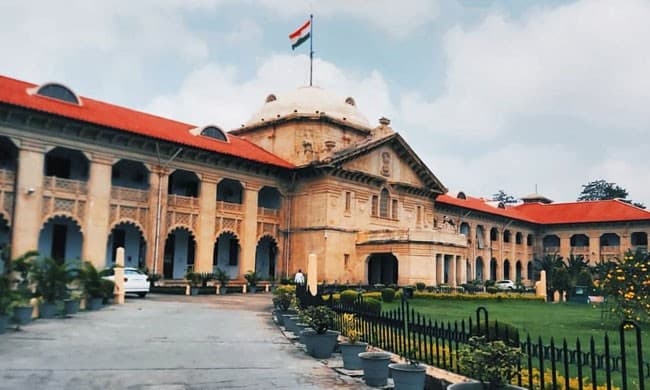
The Bench comprising Justice Ajit Kumar and Justice Indrajeet Shukla delivered the judgment in Kamrunnisha v. State of U.P. and 3 others, a writ petition filed by the widow of a silk weaver seeking possession of a locked portion of her allotted quarter in the Bunkar Colony, Nati Imli, Varanasi.
The Court recited the factual matrix that the petitioner's husband, Mati Ullah, had been allotted Quarter No.3 under a government sponsored housing scheme launched for silk weavers. He remained in continuous possession of the quarter and regularly paid the prescribed rent. Upon his death, the petitioner, as his widow, claimed to have inherited the possessory rights over the quarter.
Subsequent to the husband's demise, two individuals forcibly occupied a part of the quarter. The Assistant Director, Handloom and Textile Industries, Varanasi, issued notices directing the occupants to vacate. Following directions from the High Court in earlier writ petitions, the Assistant Director passed an order dated 18 October 2014 declaring that the quarter had originally been allotted to Mati Ullah and that the two occupants were trespassers. The High Court dismissed the challenge to that order, and in 2015 the encroached portion was vacated with police assistance and sealed.
Despite the vacating of the encroached area, the recovered portion of the quarter was not restored to the petitioner. She approached the High Court seeking possession of the locked part of the quarter and a determination on her application for the same.
The Court examined the counter affidavit filed by the State, which contended that no allotment had ever been issued in favour of the petitioner's husband. The Bench noted that this assertion was directly contrary to the order of dispossession passed on 18 October 2014 by an officer of the same rank. In order to resolve the discrepancy, the Court directed the Assistant Director to place on affidavit the complete allotment list of allottees in the colony, failing which he was required to appear in person.
The State failed to produce the allotment list. Consequently, the Court drew an adverse inference against the State's position and treated the fact stated in the 18 October 2014 order—that the quarter had been allotted to Mati Ullah—as correct. The Court emphasized that this finding had remained unchallenged throughout multiple rounds of litigation before the Bench.
Further, the Court referred to the Committee constituted in 1996 for identifying the occupants of the Bunkar Colony. The Committee's list placed the petitioner's husband at serial number three, thereby acknowledging him as a legitimate occupant. The State had never questioned the petitioner's status as the wife of a valid allottee in the earlier proceedings.
Having established that the allotment could not be disputed, the Bench held that there was no justification for the authorities to withhold possession of any part of the quarter, especially after the unauthorized occupants had been evicted. The Court described such retention of possession as wholly illegal, arbitrary and lacking any authority of law.
The Bench held that the respondents could not be permitted to act in contradiction to their own records and orders. Accordingly, the writ petition was allowed. The Court directed the Assistant Director to restore possession of the locked portion of the quarter to the petitioner forthwith. Additionally, the Court ordered that a transfer deed be executed in favour of the petitioner as the successor of her late husband, Mati Ullah.
The judgment underscores the principle that hereditary occupations such as weaving entail a continuity of rights that survive the death of the original allottee, and that state authorities must honour their own allotment decisions unless lawfully varied.