Background
The petitioner, Vijay Singh, was appointed in the Irrigation Department of Uttar Pradesh in 1989 and later posted as a Seenchpal. Following a 2014 administrative merger that required his transfer to Shikohabad, he represented on 16 February 2015 that a physical ailment prevented him from performing his duties and sought alternative posting. When alternative work was not granted, he applied for voluntary retirement under Rule 56(c) of the Uttar Pradesh Fundamental Rules, which permits a government servant to retire voluntarily after attaining forty‑five years of age and completing twenty years of qualifying service.
On 29 January 2016 the Executive Engineer sanctioned two spells of absence – from 1 February 2015 to 28 February 2015 and from 1 April 2015 to 29 January 2016 – as leave without pay under Fundamental Rule 73. In a separate order the same officer granted the petitioner voluntary retirement under Rule 56(c). The petitioner subsequently challenged the leave sanction to the extent that it denied him salary for the periods of absence, contending that Fundamental Rules 56 and 73 do not contemplate leave without pay and that, if his absence was illegal, the appropriate recourse would have been disciplinary proceedings rather than a salary denial.
Tribunal Proceedings
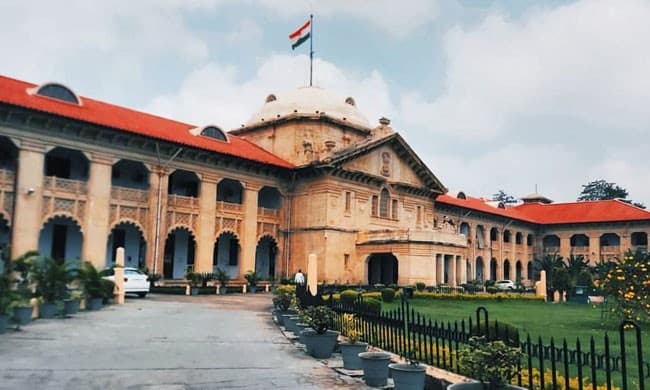
The Uttar Pradesh State Public Services Tribunal dismissed the claim on 7 March 2019, holding that the leave without pay was validly sanctioned. The petitioner then approached the Allahabad High Court by way of a writ petition challenging the Tribunal’s order.
High Court’s Analysis
A Division Bench comprising Justice Alok Mathur and Justice Amitabh Kumar Rai examined the substantive arguments. The Court first noted that Fundamental Rule 73 applies only where a servant remains absent after the expiry of sanctioned leave. In the present case the petitioner had not been on any sanctioned leave prior to the periods in question; consequently Rule 73 was not attracted.
The Bench held that the leave without pay had been sanctioned to regularise the petitioner’s unauthorised absence so as to facilitate his voluntary retirement. The Court found that the proper provision for such regularisation was Fundamental Rule 85, which empowers the authority to sanction extraordinary leave retrospectively by converting absence without leave into leave. The erroneous citation of Rule 73 instead of Rule 85 did not, in the Court’s view, invalidate the order.
The Court further observed that, had the leave not been sanctioned, the petitioner’s unauthorised absence would have constituted an interruption in service under Regulation 420 of the Uttar Pradesh Civil Services Regulations. Such an interruption would have resulted in the forfeiture of past service, thereby depriving him of the qualifying service necessary for voluntary retirement under Rule 56(c). In other words, the regularisation of absence was a precondition for the grant of retirement benefits.
The Bench then turned to the petitioner’s contradictory stance. It held that the petitioner was seeking to avail the benefit of voluntary retirement – which was predicated on the regularisation of his absence – while simultaneously challenging the very mechanism that made that benefit possible by denying salary for the same period. The Court characterised this conduct as invoking the doctrine of approbate and reprobate, stating that a party cannot approbate and reprobate the same transaction.
The Court quoted its own observation: “The conduct of the petitioner amounts to availing the benefit of voluntary retirement arising out of the same set of facts, while simultaneously challenging the denial of salary for the period of absence. Such conduct cannot be appreciated and is hit by the doctrine of approbate and reprobate.” It added that allowing the petitioner to claim the benefit of voluntary retirement on one hand and contest the salary denial on the other would defeat the purpose of the regularisation.
Operative Outcome
Having found the petitioner’s claim untenable, the Bench dismissed the writ petition. Although the Court noted that the matter was a fit case for imposing costs for abuse of process, it refrained from doing so in view of the petitioner’s retirement in 2016.
The decision underscores that a government servant who obtains a benefit – such as voluntary retirement – on the basis of an administrative regularisation cannot later challenge an incidental consequence of that regularisation, namely the denial of salary for the period covered by the regularisation, without running afoul of the principle of approbate and reprobate.