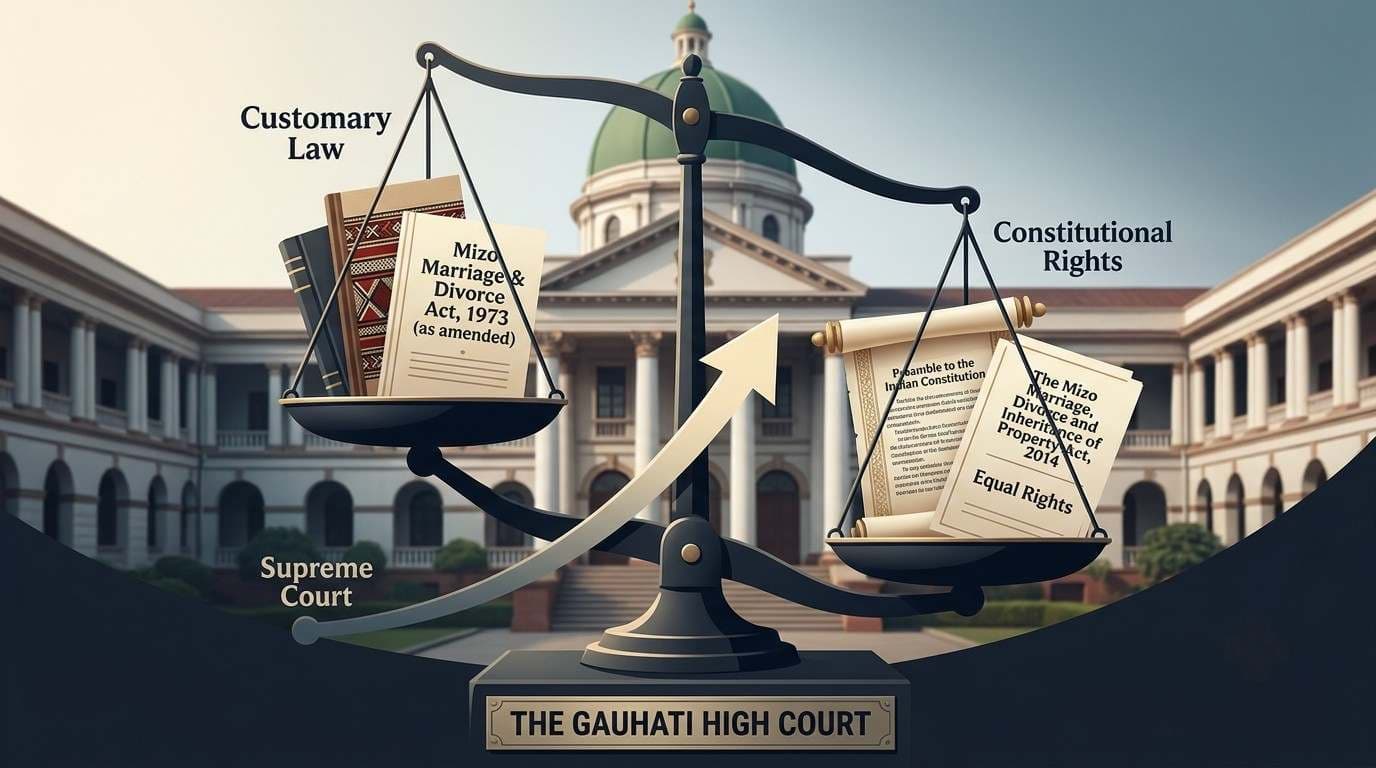
The Supreme Court recently declined to entertain a petition challenging the 2026 amendments to the Mizo Marriage Divorce and Inheritance of Property Act 2014, which the petitioner contended were discriminatory against Mizo women marrying non-Mizo men. A bench comprising Chief Justice of India Surya Kant, Justice Joymalya Bagchi, and Justice V Mohana observed that the matter could be effectively addressed by the jurisdictional High Court.
The bench noted the petitioner’s apprehension that the matter might not be heard fairly at the Aizawl Bench of the Gauhati High Court due to a charged atmosphere. In consideration of this concern, the Court granted the petitioner liberty to approach the Principal Bench of the Gauhati High Court in Guwahati for adjudication of the dispute.
The petition, filed as WP(C) No 1046 of 2026 by Meriam L Hrangchal against the State of Mizoram, specifically challenged amendments to Sections 2, 3(m), 25, and 26(1) of the Mizo Marriage Divorce and Inheritance of Property Act 2014. According to the petition, the amended Section 2 restricts the applicability of the Act to marriages where both spouses are Mizo or where only the husband is Mizo. This provision effectively excludes a Mizo woman marrying a non-Mizo man from the statutory framework, while a Mizo man remains covered regardless of his spouse’s identity.
The petitioner further contended that the amendment to Section 3(m), which redefines the term ‘Mizo’, introduces a strictly patrilineal standard by requiring that an individual must either be born a Mizo or have a father belonging to the Mizo tribe to qualify under the Act. This replaces the earlier definition, which included persons by birth, adoption, or those accepted by the community. The petitioner argued that this change, when read with Section 2, marginalises the independent identity of Mizo women and could lead to unequal treatment of children born to Mizo women who marry outside the tribe.
It was also submitted in the petition that in Mizoram, issues of inheritance, succession, and rights are intrinsically linked to the Mizo tribal framework. Consequently, the impact of the amendments extends beyond matrimonial status to affect proprietary and inheritance interests, as well as access to protection as Scheduled Tribes under Articles 341 and 342 of the Constitution.
The petition additionally challenged the omission of an explicit statutory safeguard in Section 26(1) that previously protected a woman’s personal property from interference. It also contested Section 25, which introduces a 50% statutory limitation on a woman’s share in matrimonial property, arguing that such provisions result in unequal treatment under the law.
Appearing for the petitioner were Senior Advocate Anupam Raina and advocates Pulkit U Agarwal, Prerak Khurana, Helen Lalthanpari, Sudhanshu Kaushesh, Anubhav Lamba, Rajat Kumar, Sudhanshu Kumar, Shubham Singh, Siddarth Malhotra, Md Anas Chaudhary, Zahid Taj Ali, Ankur Parihar, Mohit Agarwal, and AoR Pulkit Agarwal.
The Supreme Court, while refusing to entertain the petition at this stage, emphasised that the issue requires preferential attention and deemed it appropriate for the High Court to examine the matter in the first instance. The order reflects the Court’s approach of directing petitions to the appropriate jurisdictional forum when viable remedies exist at the High Court level, even while acknowledging procedural concerns raised by the petitioner regarding forum neutrality.