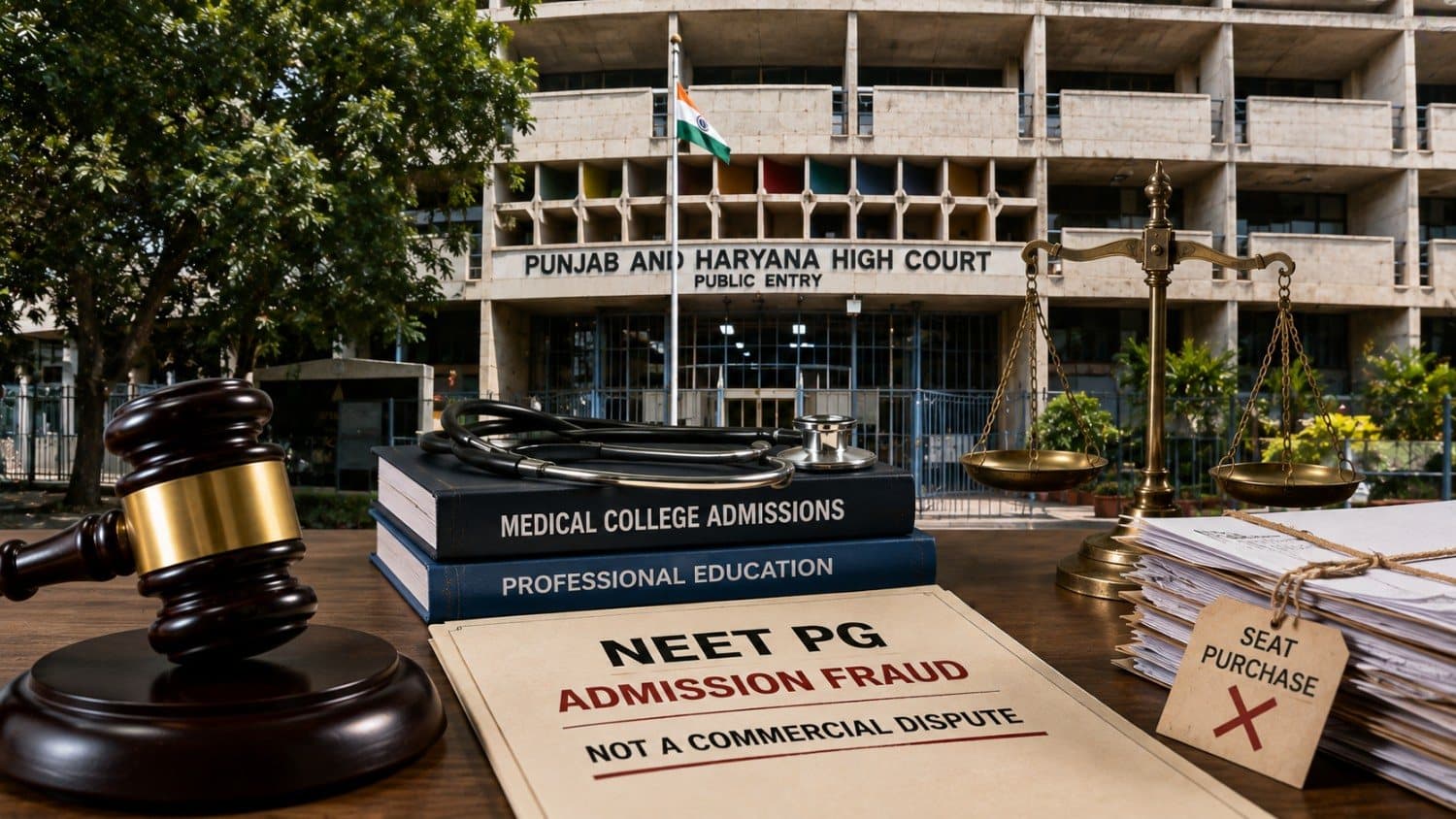
The Punjab and Haryana High Court has dismissed an anticipatory bail petition filed by an individual accused in a case involving alleged fraud in NEET-PG admissions. The court held that an attempt to secure a postgraduate medical seat through monetary payment cannot be regarded as a mere commercial or contractual disagreement between private parties. Justice Virinder Aggarwal, presiding over the matter, observed that if the allegations are proven, such conduct would undermine the core principles of fairness, transparency, and institutional integrity that govern medical admissions in the country. The judge further noted that the issue gains heightened relevance in the current context, where public confidence in the merit-based selection process is reportedly under strain due to recurring allegations of irregularities in medical entrance and admission procedures.
The First Information Report (FIR) was lodged at Faridabad Central Police Station under Sections 3(5), 318(4), 351(3) and 61(2) of the Bharatiya Nyaya Sanhita, 2023, which correspond to Sections 34, 420, 506 and 120-B of the Indian Penal Code. According to the prosecution's case, the complainant approached the petitioner and two co-accused, who presented themselves as educational consultants offering guaranteed admission to an MD/MS programme at a reputed medical college. Relying on these assurances, the complainant made multiple payments aggregating to approximately Rs 14.25 lakh towards admission and consultancy fees. It is alleged that despite receiving the funds, the accused failed to secure the admission, subsequently demanded additional money under the pretext of confirming the seat, and when the complainant sought a refund and warned of legal action, refused to return the amount and issued threats of serious consequences.
The petitioner's counsel, Senior Advocate Pardeep Singh Poonia, contended that the transaction arose from a legitimate consultancy agreement under which the petitioner had committed to assist the complainant in securing admission to a postgraduate medical course. It was argued that the complainant had been duly informed about the counselling schedule for stray-vacancy seats set for March 20, 2025, but failed to attend within the prescribed timeframe. Furthermore, it was submitted that the petitioner had cooperated with the investigation by responding to a notice issued under Section 35(3) of the Bharatiya Nagarik Suraksha Sanhita and had produced the documents requested. The repeated issuance of notices seeking identical documents was cited to demonstrate that there had been no evasion of investigation or concealment of material facts, thereby rendering custodial interrogation unnecessary at this stage.
In opposition, the Additional Advocate General for Haryana, supported by Senior Advocate Kunal Dawar appearing for the complainant, emphasized that the allegations pertain to a significant financial transaction induced through false representations about securing admission to a medical course. They submitted that, considering the nature, gravity, and seriousness of the accusations, along with the manner in which the alleged offence was committed, the petitioner was not entitled to the relief of anticipatory bail. Regarding the consultancy defence, the court examined the agreement relied upon by the petitioner and found, on a prima facie basis, that it did not establish the petitioner as the proprietor or owner of the entity in question. Moreover, the financial consideration outlined in that agreement was limited to Rs 3 lakh—comprising Rs 50,000 for registration and Rs 2.5 lakh for consultancy charges. In contrast, the allegations indicate that Rs 10 lakh was transferred to the bank account of the petitioner's father, and an additional Rs 2.75 lakh was routed via PayTM to the petitioner's personal account.
The court held that the scale and pattern of the alleged financial transactions prima facie exceed the scope of the consultancy arrangement purported by the defence. It concluded that custodial interrogation could not be deemed unwarranted at this juncture of the investigation. The court directed the investigating agency to trace the complete money trail, elucidate the exact modus operandi, identify the origin and final destination of the allegedly received amounts, determine the individuals constituting part of the alleged network, and ascertain the respective roles, extent, and inter se relationships of those involved in the suspected conspiracy. Taking these factors into account, the court dismissed the anticipatory bail petition.
The case is titled Shahnaz Hussain v. State of Haryana. The petitioner was represented by Senior Advocate Pardeep Singh Poonia, assisted by Advocates Sauhard S. Hooda, Mukul Malik, and Pulkit Dhanda. The State of Haryana was represented by Additional Advocate General Ramesh Kumar Ambavta, while the complainant appeared through Senior Advocate Kunal Dawar, assisted by Advocate Jagjot Singh.