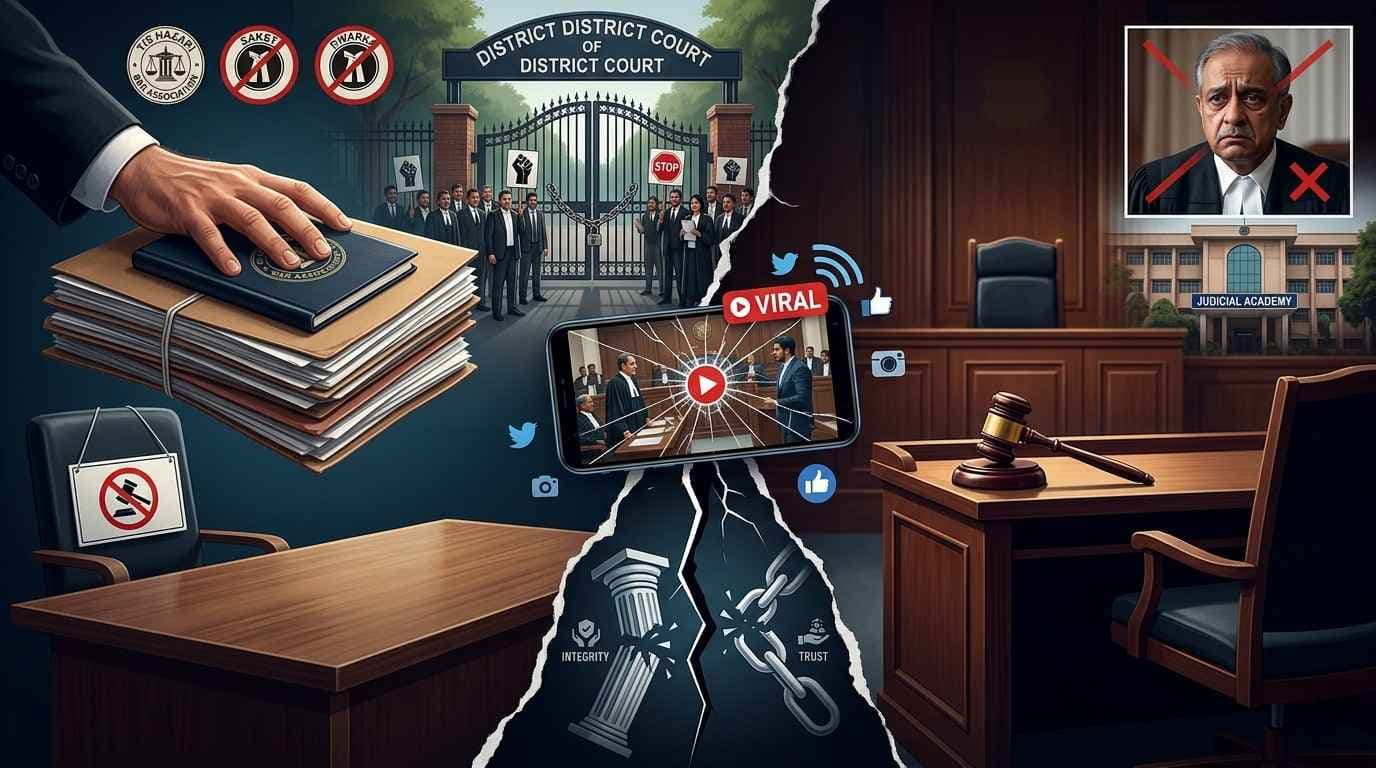
The delicate relationship between the Bar and the Bench is the foundational architecture upon which the integrity of any judicial institution rests. When that relationship fractures in open court, the administrative machinery of justice drops to a sudden halt. In an unprecedented escalation of internal friction, lawyers across all district courts in Delhi have collectively resolved to abstain from judicial work. The flashpoint for this widespread protest is a highly contentious, bitter altercation that erupted inside a courtroom at the Rohini District Court complex, triggering a swift and protective response from the region's legal fraternity.
The immediate catalyst for the strike was a mobile video capturing a heated verbal showdown that spread rapidly across social media platforms. The confrontation took place during active court proceedings between District Judge Rakesh Kumar and an advocate who also serves as the President of the Rohini Court Bar Association. According to sources within the court, the friction began over a standard procedural matter when the judge denied the counsel's request for a passover. The argument escalated into a shouting match, with the lawyer accusing the judicial officer of utilizing derogatory language and the judge warning the practitioner against issuing institutional threats.
Following the circulation of the viral footage, the Coordination Committee of All District Court Bar Associations in Delhi convened an emergency session to deliberate on the matter. The leadership body passed a unanimous resolution strongly condemning the judge's behavior, classifying it as highly objectionable, unbecoming of a judicial officer, and deeply damaging to the dignity of the legal profession. To register their institutional resentment and stand in solidarity with their colleague, the committee issued a directive calling upon all members across every district facility in the capital—including Tis Hazari, Saket, Dwarka, and Patiala House—to completely withdraw from their daily judicial duties.
Recognizing the severity of the institutional crisis and the threat of prolonged administrative paralysis, the Delhi High Court intervened with remarkable agility. Within hours of the Bar’s call for a strike, the Chief Justice and senior judges of the High Court issued an administrative order immediately stripping the embattled district judge of his judicial responsibilities. To defuse tension and preserve institutional order, the High Court attached him to the Delhi Judicial Academy in a diverted capacity, replacing him with a senior administrator from the academy to ensure the Rohini court's roster could be managed neutrally moving forward.
While the High Court’s swift intervention succeeded in removing the immediate source of the Bar's grievance, the underlying structural debate regarding courtroom behavior remains deeply polarizing. In the immediate aftermath of the order, the Delhi District Judges Association issued a strong statement expressing deep concern over the incident. The body characterized the secret recording and public circulation of internal courtroom arguments as a direct assault on the independence and authority of the judiciary. They argued that such practices create an environment of intimidation, making it difficult for judicial officers to maintain discipline and enforce procedural rules without the fear of public targeted campaigns.
This dramatic standoff highlights a growing structural challenge within the lower courts, where the immense pressure of handling overloaded rosters frequently tests the limits of professional patience. While judges must wield the authority to manage their courtrooms efficiently and prevent unnecessary delays, that authority must always be exercised with institutional courtesy and respect for the advocates appearing before them. Conversely, members of the Bar are expected to maintain strict adherence to court protocol, ensuring that vigorous advocacy never crosses the line into personal confrontation or structural disruption.
Ultimately, this strike serves as a reminder of how fragile institutional harmony can be when mutual respect breaks down between the two main pillars of the justice system. The rapid intervention by the Delhi High Court demonstrates an institutional awareness that public confidence in the legal system cannot survive open hostility between those who administer the law and those who practice it. As formal inquiries begin to investigate the root causes of this specific courtroom clash, the broader legal community faces the challenge of rebuilding a workspace where professional boundaries are strictly respected and the dignity of the court is maintained by both sides of the dais.