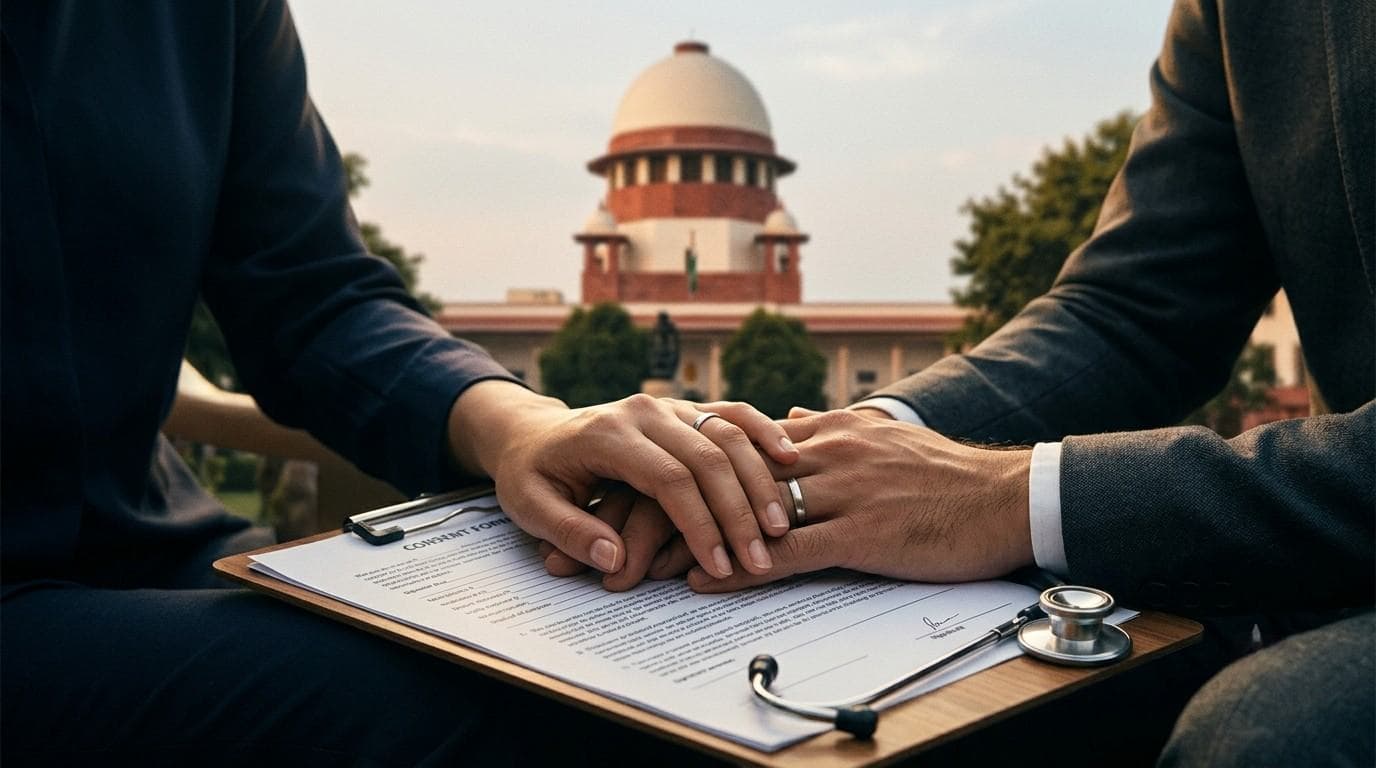
The Delhi High Court on Thursday questioned the Central Government's failure to respond to a plea seeking recognition of non-heterosexual partners as medical representatives for decision-making in medical situations. Justice Swarana Kanta Sharma made the observation while hearing a petition filed by Arshiya Takkar, who seeks framing of guidelines to permit a same-sex partner to act as a duly constituted medical representative and give consent during medical treatment or emergencies.
The petitioner has alternatively prayed for a declaration that an advance medical power of attorney executed by a patient in favour of their non-heterosexual partner should be sufficient to authorise such partner to make medical decisions on their behalf. Senior Advocate Saurabh Kirpal, appearing for the petitioner, submitted that notice was issued in the matter as far back as July last year, yet no counter affidavit has been filed by the Central Government.
Referring to judicial precedents, Kirpal submitted that while the Supreme Court has held that same-sex marriage cannot be recognised, it has simultaneously acknowledged the right to live in a relationship. He argued that denying medical decision-making rights to partners in such relationships contradicts the essence of Article 21 of the Constitution. He quoted, 'You can't simply say you two now live together but you can't do anything together. And then we will recognise your right to live in relationship, we will not put you in jail but you can't do anything else. That is not mandate of Article 21.'
Justice Sharma responded to this submission by stating, 'How about this. The law recognizes live in relationship between a man and a woman. Why will it not allow a live in relationship between a man and a man? Let's just say what they have to say. It will be very interesting.' She further questioned the Centre's counsel, asking whether any decision had been taken on the matter.
The judge elaborated that individuals choosing paths not taken by the majority often face social targeting or non-acceptance, citing instances where families disown such persons. She noted that when near relations are unavailable or unwilling to take decisions, the patient's chosen partner—whom they consider as a spouse—should be permitted to step in. 'When you say they are not available, they are available but they don't want them to take a decision,' she remarked.
Justice Sharma emphasised that the plea is limited to medical consent situations and would also benefit divorced persons living with partners without remarriage, or women living with women whose families have disowned them. She remarked that passing an order in this regard would require only safeguards, referencing a Madras High Court judgment as a possible reference. 'I was just wondering. If I pass an order in this regard, you don't need to change anything. For that you only need to put in safeguards. For that you can also think of the Madras High Court judgment. You can also think of some other good thing. This is such a small thing. Why can't you do it?', she said.
The Court directed the Central Government to file a counter affidavit within one week and listed the matter for final hearing next month, terming it an issue of importance. The petition highlights that Clause 7.16 of the Indian Medical Council (Professional Conduct, Etiquette and Ethics) Regulations, 2002, restricts medical consent to 'husband or wife, parent or guardian in the case of minor, or the patient himself', thereby excluding same-sex partners. The plea contends that this exclusion lacks a reasonable nexus with any legitimate state objective, is manifestly arbitrary, and violates Articles 14 and 21 of the Constitution by creating a disparate impact on non-heterosexual unions.