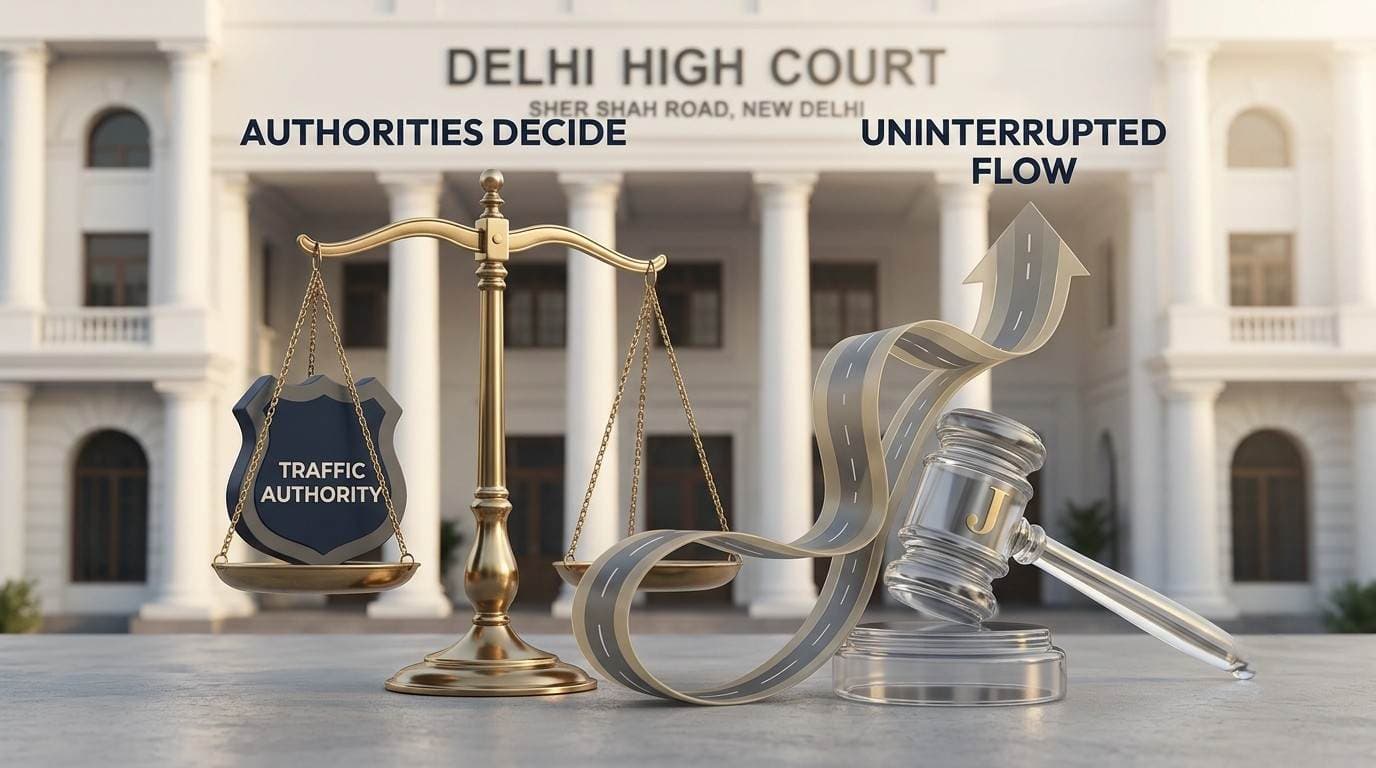
The Delhi High Court dismissed a writ petition filed by advocate Saurabh Kumar Gupta seeking immediate deployment of traffic marshals in Connaught Place to address persistent traffic congestion near his office. The petitioner contended that inadequate traffic management in the area resulted in daily gridlocks, severely affecting vehicular movement and access to his premises.
Justice Amit Bansal, presiding over the matter, referred to a prior division bench ruling which had established that traffic authorities are best positioned to decide on matters concerning the regulation and flow of vehicular traffic in the city. The bench emphasized that the High Court, while exercising its writ jurisdiction, cannot function as an appellate authority over executive decisions taken by traffic police regarding traffic regulation.
The court noted that the Delhi Traffic Police had submitted that adequate personnel were deployed during peak hours and that the concerns raised by the petitioner were being addressed through existing mechanisms. It further observed that the issue of traffic management involves operational discretion and expertise that lies within the domain of administrative bodies, not judicial oversight via writ jurisdiction.
Justice Bansal stated that the petition could not be entertained as it sought judicial intervention in a matter that falls squarely within the purview of executive decision-making. The court reiterated that unless there is a clear violation of statutory duty or illegality, the judiciary should not substitute its judgment for that of the concerned authorities in technical and administrative matters such as traffic regulation.
The Delhi High Court concluded that the writ petition lacked merit and was not maintainable, as it impermissibly sought to direct the traffic authorities on operational deployment. Accordingly, the petition was dismissed with costs, if any, to be borne by the petitioner.
The judgment reaffirms the principle that courts must exercise restraint in interfering with routine administrative functions, especially where specialized authorities possess the necessary expertise and are functioning within their statutory mandate. The observation underscores the limits of judicial review in matters involving day-to-day governance and public order management.
The ruling serves as a precedent reinforcing the separation of powers, affirming that while courts can intervene to prevent arbitrariness or illegality, they cannot direct administrative bodies on how to perform their routine duties unless such directions are warranted by a breach of legal duty.
The case is cited as Saurabh Kumar Gupta v. Delhi Traffic Police and Others, decided on 22 August 2026.
The order clarifies that the High Court will not entertain writ petitions challenging routine traffic management decisions absent a showing of illegality, irrationality, or failure to perform a statutory duty.