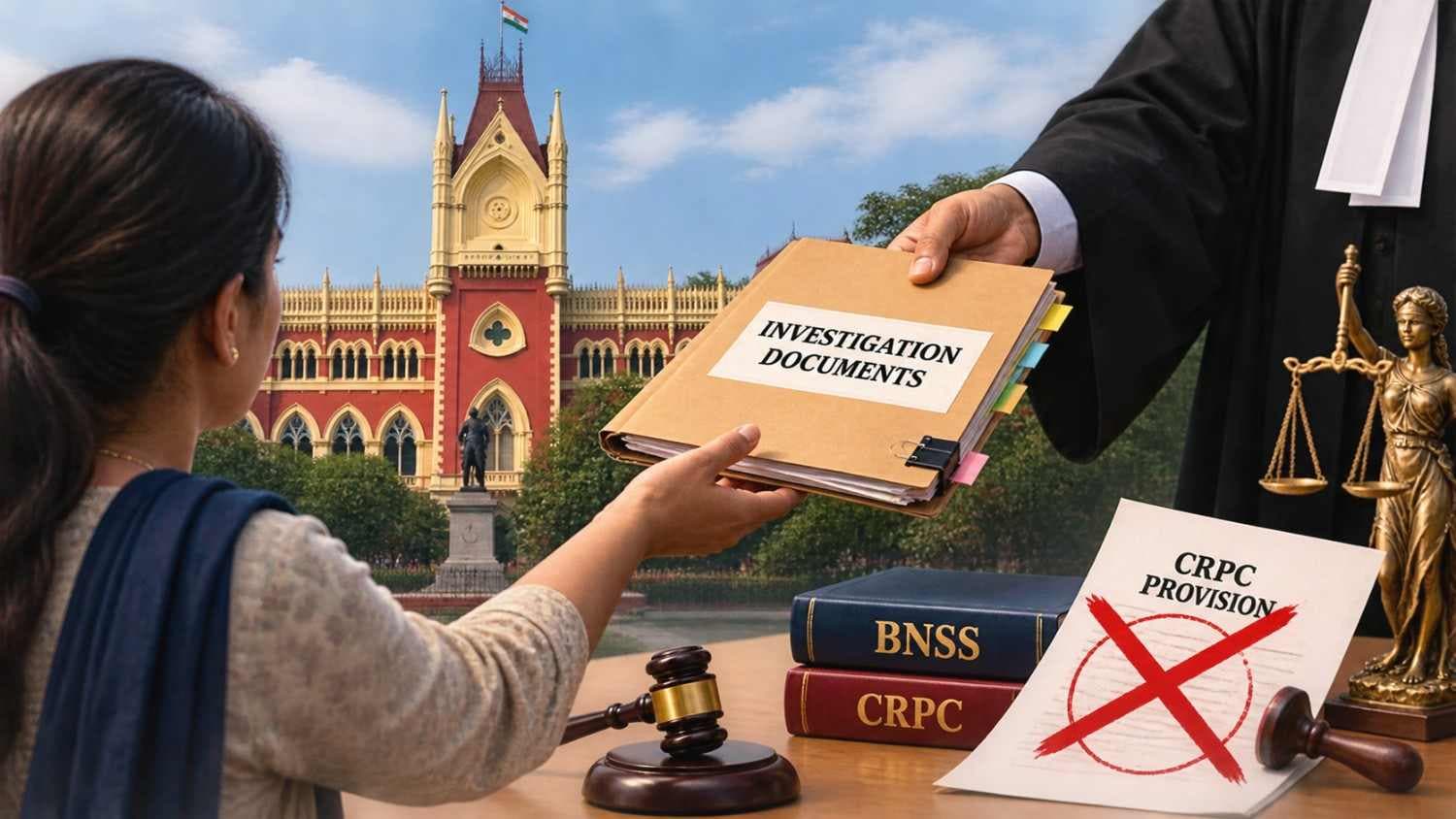
The Calcutta High Court has unequivocally stated that a victim in a criminal proceeding is entitled to receive copies of investigation documents as stipulated under Section 230 of the Bharatiya Nagarik Suraksha Sanhita (BNSS), 2023. The Court, through Justice Dr. Ajoy Kumar Mukherjee, held that a substantive legal right cannot be defeated solely due to the applicant's erroneous citation of a statutory provision in their plea.
The ruling came in a challenge against an order issued by the Judicial Magistrate, 17th Court, Calcutta, which had rejected an application from a victim seeking legible copies of documents forming part of the investigation material in connection with G.R. No. 798 of 2022. The Magistrate's order, dated February 6, 2025, was predicated on the reasoning that the charge-sheet had been filed and the trial had commenced while the Code of Criminal Procedure (CrPC), 1973, was still in force. The Magistrate further noted that Section 207 CrPC and the Criminal Rules and Orders did not provide for the supply of such documents to a victim.
Background of the Case and Petitioner's Contentions
The petitioner, Sinjini Mukherjee, who was the de facto complainant and victim in the case, contested the Magistrate's decision before the High Court. She argued that her application, filed on July 15, 2024, though mistakenly referencing Section 207 CrPC, was fundamentally an application seeking relief under Section 230 BNSS. Section 230 BNSS specifically mandates the furnishing, free of cost, of copies of specified documents to the accused and also to the victim, provided the victim is represented by an advocate.
The State opposed the petitioner's plea, asserting that the application explicitly invoked Section 207 CrPC, a provision that did not confer any right upon the victim to obtain the requested documents.
BNSS Applicability and Repeal of CrPC
The High Court rejected the State's arguments by examining the repeal and savings provisions outlined in Section 531 of the BNSS. Justice Mukherjee observed that the BNSS came into force on July 1, 2024, thereby repealing the CrPC. While Section 531(2)(a) of the BNSS preserves proceedings that were already pending immediately before the new law's commencement, it does not extend to applications instituted after that date. Given that the victim's application for documents was filed on July 15, 2024, the High Court concluded that Section 230 BNSS was the applicable legal framework. The Court explicitly stated that any application filed on or after July 1, 2024, must be governed by the provisions of BNSS, as the CrPC stood repealed by that date. Consequently, the High Court held that the Magistrate was legally obligated to furnish the documents contemplated under Section 230 BNSS to the victim.
Substance Over Form: The Principle of Legal Remedy
Addressing the argument that the incorrect reference to Section 207 CrPC should be fatal to the application, the High Court firmly rejected this contention. Justice Mukherjee underscored that a litigant's primary responsibility is to present the relevant facts to the court, while it is the court's inherent duty to apply the correct law. The Court emphasised that a prayer must always be considered in its substance rather than merely its form. It further clarified that a court is not absolved of its obligation to determine the actually applicable statutory provision simply because a litigant has referred to an incorrect statute or section. The High Court remarked that it is the business of the court to know the law, and a precise recitation of the applicable statutory provision is not a prerequisite for a victim to secure a legal remedy.
The Court also referenced Rule 252 of the Calcutta High Court Criminal (Subordinate Courts) Rules, 1985, which permits parties to criminal proceedings to obtain certified and uncertified copies of inquiry materials, including police papers that may be utilised as evidence during trial or inquiry, and the final police report.
Victim's Right to Effective Participation
The High Court further considered the petitioner's argument that access to investigation documents was crucial for her to ascertain whether the investigation had been conducted properly and, if necessary, to take appropriate legal steps, including filing a protest petition. In support of this, the Court relied on the Supreme Court's judgment in Jagjeet Singh & Ors. v. Ashish Mishra @ Monu & Anr., reported in (2022) 9 SCC 321. This Supreme Court precedent affirmed that a victim possesses a right to participate effectively in criminal proceedings and must be afforded an opportunity for a fair and effective hearing whenever they come forward to participate. The Calcutta High Court reiterated that a victim cannot be denied this fundamental right.
Court's Disposition
In light of these observations, Justice Dr. Ajoy Kumar Mukherjee set aside the Magistrate's order. The High Court directed the trial court to provide the victim with copies of all documents covered by Section 230 of the BNSS within ten days from the communication of its order.