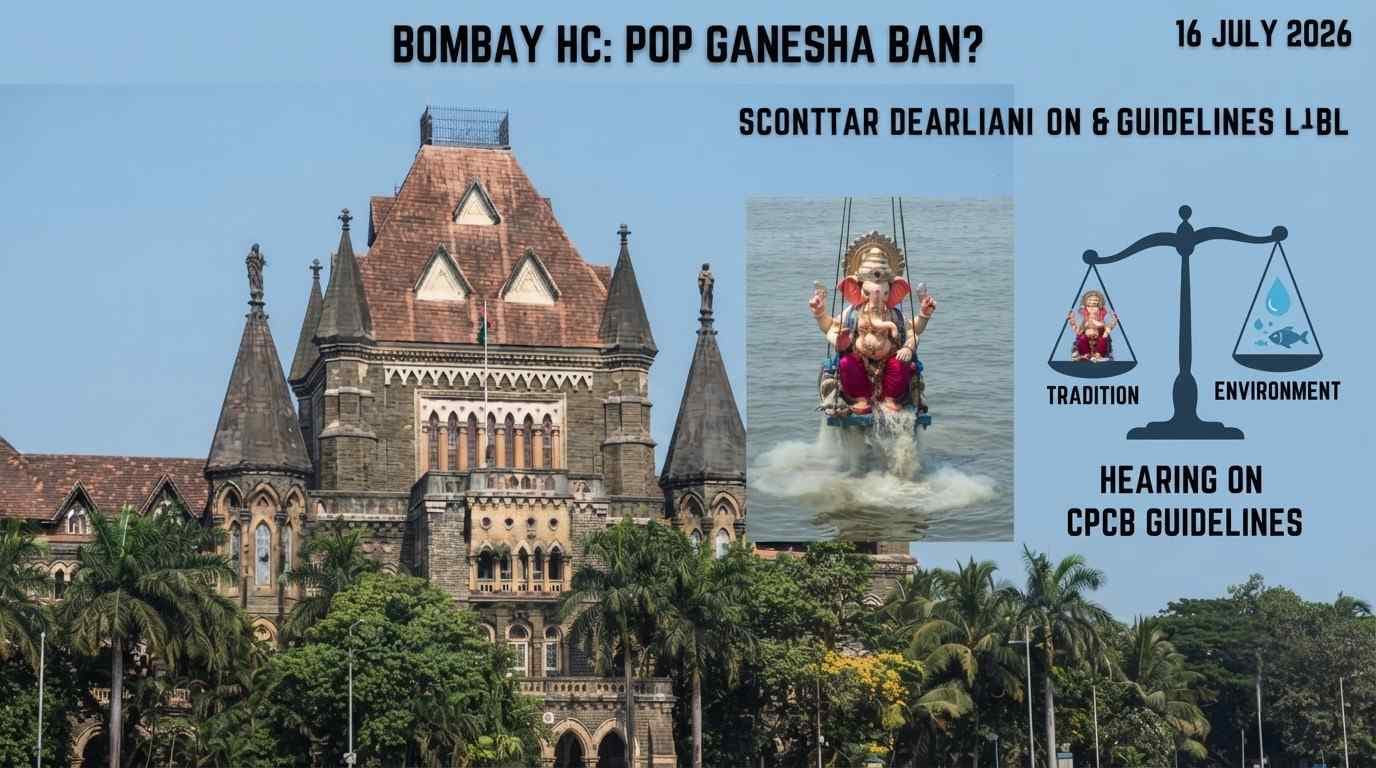
On Wednesday, 15 July 2026, a division bench of the Bombay High Court comprising Justices Ajay Gadkari and Kamal Khata commenced hearing the final arguments in a public interest litigation that seeks effective implementation of the Central Pollution Control Board guidelines relating to the immersion of Ganesha idols made of plaster of paris.
The petition was brought before the court on the ground that the immersion of large plaster of paris idols, particularly those exceeding six feet in height such as the widely known Lalbaugcha Raja, results in water pollution. The petitioner’s counsel submitted to the court that the objective of the litigation is not to hurt any religious sentiments but to address the adverse impact on water bodies caused by the dissolution of plaster of paris material.
During the hearing, the bench was informed that the petitioner seeks direction to the concerned authorities to ensure that the immersion of such idols does not take place in natural water bodies, including rivers, lakes and seas. The submission emphasized that the preservation of water quality and the protection of aquatic life constitute a matter of public interest that warrants judicial intervention under Article 226 of the Constitution.
The petitioner further contended that the continued immersion of plaster of paris idols leads to the release of calcium sulphate and other compounds that increase turbidity and affect the chemical composition of water, thereby contravening the provisions of the Water (Prevention and Control of Pollution) Act, 1974. The counsel argued that the state is obligated to enforce the Central Pollution Control Board’s advisories which prohibit the immersion of non‑biodegradable idols in natural water sources.
In response to the submissions, the bench observed that the issue raised involves a balance between the freedom to practice religion under Article 25 and the duty to protect the environment under Article 21. The court noted that the petitioner’s stance is expressly framed as an effort to prevent water pollution without intending to interfere with religious observances.
The division bench indicated that it would consider the arguments presented and the materials on record before pronouncing any order. No interim direction was issued at this stage, and the matter remains pending for final adjudication.
The hearing underscored the recurring tension between traditional festive practices and environmental safeguards, a topic that has been the subject of several judicial pronouncements in recent years. The parties are expected to address the feasibility of alternative immersion arrangements, such as the use of designated artificial tanks, in the subsequent stages of the litigation.
As the proceedings continue, the Bombay High Court’s deliberation will focus on whether the existing regulatory framework, particularly the directives of the Central Pollution Control Board, is being adequately implemented to mitigate water pollution arising from the immersion of plaster of paris Ganesha idols during the annual Ganesh Chaturthi celebrations.